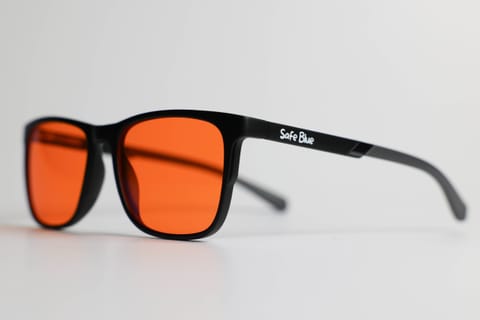
Prescription blue light glasses: the honest guide
Got a prescription and want a blue light filter? Filters built into prescription lenses, the questions to ask your optician, and why SAFEBLUE is plano only.
· 13 min read
If you have short sight, long sight, astigmatism or presbyopia, the blue light filtering glasses you find online — almost all of them plano, that is, without correction — aren’t for you, at least not as your only solution. It’s a point we prefer to be clear about from the start, not least because it applies to our own product: SAFEBLUE Classic is a plano pair, not prescription, and if you have a refractive error to correct it can’t replace your prescription glasses.
The right route, in this case, almost always runs through the optician. Prescription lenses can incorporate a blue light filter, and this lets you have correction and filter in a single pair of glasses, with no stacking. It’s a well-trodden path, but with two snags worth knowing before you walk into the shop: the filter built into prescription lenses is almost always clear (and therefore low-filtration, not comparable to an orange lens), and the mark-up can vary a lot from one supplier to another for products that, on paper, filter much the same.
In this guide we explain how the filter works in prescription lenses, which questions to ask your optician so you don’t buy blind, how much to expect to spend, and — with the same honesty — when the optician route really is the best one and when you’re better off combining it with a separate evening filter. No clinical promises: just practical information to decide well.
At the optician: how the filter goes into prescription lenses
When you order new prescription lenses, the blue light filter is one of the options the optician can add. Technically there are two ways of doing it, and it’s useful to know which one you’re being offered.
Filter as a reflective coating. A multi-layer coating is applied to the surface of the clear lens, reflecting back some of the short wavelengths. It’s the most common solution: you recognise it by the bluish or violet reflection the lens shows when you tilt it under a light. It keeps the lens optically clear, with at most a barely perceptible straw tinge. The limit is the filtration: a coating that blocked a lot would be a blue mirror, so the figures stay modest, typically with a blocking peak around 410–420 nm and little effect at the real screen peak (450–460 nm).
Absorbing filter in the body. A pigment is built into the lens material, which absorbs the short wavelengths. It allows higher filtration, but pushed far it introduces an increasingly warm colour cast: that’s why, in prescription lenses for everyday use, body absorption is almost always kept light (a faint straw or just-yellow tint). No optician will offer you distinctly orange varifocals to wear all day, and for good reason: the permanent cast would be unmanageable and would make any colour judgement unreliable.
In both cases, the practical consequence is the same: the filter you get in a prescription lens is a light filter, a side feature. It isn’t the 95–99% of a dedicated orange lens. It’s the compromise needed for the lens to stay clear and wearable all day — the same principle we explain in orange vs clear lenses.
The questions to ask your optician
The most common mistake is to ask generically for “the blue light filter” and accept whatever the counter offers. “Blue light” filter isn’t a single standard: under that name, products that filter in very different ways are sold. Here are the questions that give you real information.
- “Can you show me the spectral transmission curve of this filter?” This is the key question. A serious maker provides the graph, or at least the per-band blocking percentages (at 410 nm, 450 nm, 480 nm). If the answer is only “it blocks harmful blue light” with no numbers, you’re buying a slogan.
- “What’s the blocking percentage at 450–460 nm?” That’s the real emission peak of monitors, phones and TVs. Many filters quote the figure at 410–420 nm, where they’re most effective but where screens emit very little. The figure that matters is the one at the real peak.
- “Is it a reflective coating or a filter in the body?” It changes the look (bluish reflections vs a faint tint) and scratch resistance.
- “How much does the same lens cost without the filter?” Only this way do you see the filter’s real impact on the price, rather than a total in which it’s drowned.
- “Does it create visible reflections on video calls?” Reflective coatings can show bluish reflections that the person you’re talking to sees on your lens. If you spend many hours on calls, it’s a factor.
- “Can I try them and return them if I’m not convinced?” Policies vary; better to know beforehand.
A good optometrist won’t take offence at these questions: they read them as the sign of an informed customer. If instead you sense reticence about the spectral data, that’s a signal it’s worth getting a second quote elsewhere. Our general checklist is in how to choose blue light glasses.
How much it costs: the filter mark-up
In the Irish and EU market, adding the blue light filter to prescription lenses typically adds €30–100 per pair compared with the same lenses without a filter. The final price depends far more on the type of base lens than on the filter itself:
| Type of prescription lens | Indicative cost without filter | With blue light filter (total) |
|---|---|---|
| Standard single vision | €50–150 | €80–250 |
| High-end single vision (premium anti-reflection, thin) | €150–300 | €200–400 |
| Mid-range varifocal | €200–400 | €250–500 |
| High-end varifocal | €400–700 | €450–800 |
These are wide ranges because the optical market is wide: the same nominal filter can cost different amounts depending on the chain, the lens maker and the anti-reflection coating paired with it. Hence the importance of question 4: getting the lens quoted with and without the filter is the only way to understand exactly what you’re paying for the filter. For the full price picture, plano and prescription, see how much blue light glasses cost.
A point of method, which has to be made: the 2023 Cochrane systematic review — conducted largely on clear filtering lenses just like the ones your optician offers — found no clear difference in short-term visual fatigue compared with ordinary lenses, and the evidence on sleep outcomes was limited and mixed. The American Academy of Ophthalmology, along the same lines, attributes much screen discomfort to usage habits rather than to the light. This doesn’t mean the filter is useless or harmful: it means the mark-up should be decided knowing you’re buying a measurable physical fact (a little less blue light) and a usage preference, not a guaranteed clinical outcome. If that framing interests you, we go deeper into it in do blue light glasses work?.
Why SAFEBLUE Classic is plano only
Let’s touch the point that concerns us directly, because we believe being honest about your own limits is part of the product. SAFEBLUE Classic is a plano pair: it carries a high-filtration orange lens (99% block between 400 and 500 nm, 85% between 500 and 530 nm, 65% visible transmission, cutoff at 530 nm), but with no vision correction. It is not a medical device and it doesn’t correct refractive errors.
Why this choice? For two technical reasons and one of transparency.
The first is filtration: our lens is orange precisely because we want to block the 400–530 nm band substantially, and that requires an absorbing pigment which — as we’ve explained above and in orange vs clear lenses — introduces a warm cast. A lens like that, prescription and worn all day, would be uncomfortable for most people and unsuited to anyone working; it makes sense as a dedicated evening pair, to wear during the hours in front of screens.
The second is customisation: a prescription lens has to be built to the individual script, with specific centring, material and geometry. It’s an optician’s service, done well by someone who measures your eyes in person — not something you ship in a one-size-fits-all box.
The third, and for us the most important, is transparency: we’d rather tell you plainly that if you have a refractive error, SAFEBLUE Classic alone isn’t enough for you, than sell you a solution that doesn’t solve your problem. For glasses wearers, we’ve devoted a dedicated guide to the workable combinations — contacts plus a plano pair, clip-on, fit-over, built-in filter — in blue light glasses: prescription or not.
The recommended route for people with a refractive error
Let’s put the pieces together into a concrete route, depending on your situation.
You need correction all day and want a “side” filter. At your next lens change, ask the optician for the clear built-in filter, asking the questions from the relevant section. You’ll know it’s a light filter, and that’s perfectly fine if that’s your expectation.
You need correction and want serious filtration in the evening. Combine two things: prescription lenses (with or without a light filter) for the day, and a separate orange filter for the 2–3 evening hours in front of screens. If you tolerate contacts, the cleanest solution is contacts plus a plano orange pair like SAFEBLUE Classic in the evening; if not, an orange fit-over over your glasses. The details are in blue light glasses: prescription or not.
You use prescription glasses for screens only (light prescription). Talk to the optician: in some cases, for certain tasks and minimal prescriptions, swapping between your glasses and a plano filtering pair in the evening hours is conceivable. It’s an individual assessment, to make with someone who knows your script.
In every case, pair the physical filter with the good habits that genuinely count according to the professional bodies: regular breaks (the 20-20-20 rule: every 20 minutes, look at something 20 feet — about 6 metres — away for 20 seconds), correct screen distance, adequate ambient lighting, and night mode on devices in the evening. You’ll find them gathered in when to wear blue light glasses and, for the software side, in night mode vs glasses.
Optician, optometrist, ophthalmologist: who to see
A useful clarification, because the roles are often confused. The optometrist measures your sight, advises on correction and makes the glasses: it’s the right person to order prescription lenses with or without a blue light filter, and to discuss the technical questions in this guide. The ophthalmologist is the medical specialist: the person to see for a check on the state of your eyes, for persistent symptoms, or for any concern that goes beyond simple correction. The blue light filter, in prescription lenses, is a product choice to make with the optician; but if you feel discomfort in front of screens that won’t go away, the sensible first stop is an eye examination, not buying a filtering pair.
This distinction matters because the blue light filter isn’t a response to a vision problem: it’s an addition for comfort. If your prescription is wrong or out of date, no filter will make up for the strain that follows — the answer is the correct correction, to be redone with the optician. Buying a filter to “see better” is a misunderstanding to avoid: the filter touches one band of the spectrum, not the sharpness of the image.
The filter doesn’t replace correction
We restate the point because it’s the source of the most frequent errors. Correction and filter are two independent functions: the first makes the image sharp according to your script, the second cuts one band of the light spectrum. A strong plano filter, like SAFEBLUE Classic, cuts blue light substantially but corrects nothing: if you’re short-sighted, through that lens you’ll see an orange and blurry screen. Conversely, a prescription lens with a light filter corrects your sight perfectly but filters little.
The practical consequence, for anyone with a refractive error, is that correction always comes first: it’s the non-negotiable requirement, and your optician gives it to you. The filter is the next, separate choice, calibrated to how much and when you use screens. It’s exactly the logic of the four options described in blue light glasses: prescription or not: they all start by sorting the correction and then add the filter in the way best suited to your case.
Frequently asked questions
Can I have prescription lenses with a blue light filter?
Yes, it’s a standard option almost every optician offers. The filter is added to your prescription lenses, usually as a clear reflective coating. Correction and filter coexist in a single pair of glasses.
Is the filter in prescription lenses as strong as an orange lens?
No. Prescription lenses with a filter are almost always clear, with modest blocking at the real screen peak (10–30% at 450–460 nm). A dedicated orange lens blocks 95–99% up to 530 nm. They’re two different categories: the first is a side filter, the second a high-efficiency evening filter.
Why doesn’t SAFEBLUE sell prescription lenses?
Because our high-filtration orange lens makes sense as a dedicated evening pair, not as a lens to wear all day, and because a prescription lens has to be built in person to your script by an optician. We prefer to be honest about our remit: if you need correction, SAFEBLUE Classic alone isn’t enough.
How much does adding the filter to prescription lenses cost?
Usually €30–100 more per pair than the same lenses without a filter, but the total depends above all on the type of lens (single vision or varifocal, base or premium). Always ask for a quote with and without the filter to see the real impact.
Is the built-in filter or a separate pair the better option?
It depends on the goal. For a light filter working all day, the built-in one is handy. For serious filtration in the evening hours, a separate orange filter is the way (over contacts or as a fit-over), because the clear built-in one doesn’t reach those levels.
Do prescription lenses with a filter alter colours?
Very little: reflective coatings leave at most a faint straw tinge, and any body tint is kept light precisely so they stay wearable all day. It’s the flip side of their modest filtration.
Can I use prescription lenses with a filter for night driving?
Clear prescription lenses with a filter have high transmission and are generally suitable for driving, but it’s the individual product that has to meet it: check with the optician for conformity with the requirements of standard EN ISO 12312-1. An orange lens, on the other hand, is not suitable for night driving because of its low visible transmission.
Does the blue light filter replace good habits in front of the screen?
No, and it’s a point the professional bodies agree on: regular breaks, correct distance, adequate lighting and blinking remain decisive for visual comfort. The filter is an addition, not a substitute for good screen use.
In short
If you have a refractive error, the route to a blue light filter runs through the optician: the filter goes into prescription lenses, usually as a clear coating, and it’s a light filter — handy because it works all day, but far from the 95–99% of a dedicated orange lens. To get serious filtration in the evening hours, the most effective route is to combine your correction with a separate orange filter: contacts plus a plano pair, or a fit-over. That’s exactly why SAFEBLUE Classic is and stays a plano pair: an evening orange lens (99% block between 400 and 500 nm, €49.90, 30-day returns) made for people who don’t need correction or who pair it with contacts. If you have a script to honour, the right first stop is an optometrist’s counter, with the questions from this guide in your pocket.
Sources
This article is for information only and does not constitute medical advice. See a qualified optometrist for any vision concerns. SAFEBLUE is a visual comfort accessory, not a medical device.
Related articles
Blue light glasses: prescription or not? All the options
You wear prescription glasses and want a blue light filter? Contacts plus plano lenses, clip-ons or filtered prescription lenses: costs and trade-offs compared.
Orange vs Clear Lens: The Real Differences
Transmission spectra, blocking percentages and colour rendering: the technical comparison between orange and clear lenses, to work out which suits you.
How to Choose Blue Light Glasses: Criteria and Data to Ask For
Blocking percentages per nm range, CR-39 or polycarbonate, visible transmission, CE and UV400: the concrete criteria for choosing blue light glasses.
Night Mode vs Glasses: What Actually Filters?
Night Shift, Night Light and f.lux shift the white balance; glasses filter the whole field of vision. Measurements, limits and how to combine them.