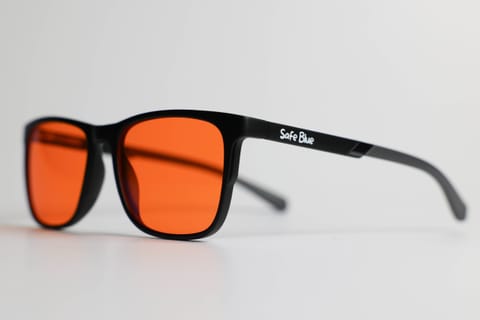
When to wear blue light glasses: a guide by time of day
Evening yes, daytime it depends, never night driving: a practical guide to when it makes sense to wear blue light glasses, with routines and examples.
· 14 min read
You’ve got a pair of blue light glasses — or you’re thinking of buying some — and you’re asking the right question: when does it make sense to wear them? All day? Only in the evening? Outdoors too? The short answer is that the moment matters more than the model: the same pair can be a sensible choice at 10pm and a poor idea at 11:30pm behind the wheel.
In this guide we reason by time of day and concrete situations, starting from a simple physical principle: blue light isn’t a poison to be avoided at all times, it’s a timing signal for your body. During the day it’s normal and even useful to receive it — the sun emits far more of it than any screen, as the American Academy of Ophthalmology reminds us. In the evening, though, it’s an out-of-hours signal: the short wavelengths are the ones that most interfere with melatonin production, as the experiments cited by Harvard Health document.
From this almost everything follows: the evening is the moment when a filter makes the most sense; during the day it depends on context and your own sensitivities; behind the wheel at night, never. The next sections lay out the full reasoning, a road-tested evening routine, and the pairings with lighting and breaks that make the whole thing coherent — because a pair of glasses worn inside the wrong routine is like an umbrella opened in the shower: technically it works, but that wasn’t the problem.
The basic principle: blue light is a timing signal
To decide when to use a filter you need to understand what you’re filtering. Visible light runs from about 380 to 700 nanometres; the “blue” portion (roughly 400–500 nm) is the one the retina’s melanopsin ganglion cells are most sensitive to — cells that aren’t for seeing but for regulating the body clock. When they receive a lot of light in that band, they tell the brain it’s daytime; when they stop, the body understands it can start the night. You’ll find the full deep dive in what is blue light.
Harvard Health reports a much-cited experiment: at equal intensity, blue light suppressed melatonin for about twice as long as green light, shifting the circadian rhythm by about 3 hours against 1.5. And this is where the filter finds its logic: an orange lens with a cutoff at 530 nm screens almost the entire action band of that signal (our filter blocks 99% between 400 and 500 nm and 85% between 500 and 530 nm), letting 65% of overall visible light through. It’s a physical figure, measurable with a spectrometer.
Two pieces of honesty before we go on. First: the 2023 Cochrane review urges caution about the whole category — the effects of filtering glasses on sleep come out uncertain in the available studies, not least because most tested clear lenses that filter little. Second: the AAO reminds us that screen discomfort depends above all on reduced blinking and long sessions, not on blue light. Translated: the filter is one piece, not the solution. Let’s see where it fits.
Evening: the moment they make the most sense
If there’s a “natural” time of day for an orange-lens pair, it’s the stretch that runs from a couple of hours before bed until lights-out. It’s the moment when your body should be starting to produce melatonin, and it’s also the moment when, statistically, you’re in front of a screen: series, last emails, social, gaming.
Harvard Health suggests avoiding bright screens in the 2–3 hours before sleep — and it’s the best advice of all. But it’s also the advice almost nobody follows, and here the pragmatic compromise enters: if the evening in front of the screen is going to happen anyway, screening the blue band in those hours is a way to reduce the “it’s daytime” signal you’re sending to the brain. It’s exactly the use a real orange lens is for, not a clear office filter: the difference between the two we explain in our comparison of orange and clear lenses.
In practice:
- put them on when your “evening phase” begins, not five minutes before sleep: the light signal acts over hours, not instants;
- keep them on as you move between screens too: the bathroom lit with cool LEDs at 11pm is evening light as well;
- pair them with warm, low ambient lights: filtering your screen while the ceiling blasts 4000 K at you is incoherent (more on this shortly);
- expect an amber cast: whites turn warm, blues go flat. It isn’t a flaw, it’s the filter doing its physical job — and after a few minutes the brain compensates for most of the cast.
Daytime: it depends (and not using them is fine too)
During the day the picture changes radically, for a reason the category’s marketing tends to forget: receiving light — including blue — during the day is physiological. Exposure to bright daytime light, ideally natural, is one of the signals that keep the body clock synced; Harvard Health explicitly advises getting plenty of light during the day precisely to sleep better at night and to stay alert during working hours.
So: do you need filtering glasses in broad daylight? The honest answer is “by default no, but there are cases where personal preference is legitimate”:
- Spaces with aggressive artificial lighting: open-plan offices with cool tubes, LED-lit warehouses, desks with strong reflections. Here some people simply find a lens that warms the image and softens the glare more comfortable. It’s a usage preference, not a documented need.
- “Early” evening sessions: shift workers, or anyone who has to sleep in the afternoon, have a “biological evening” that doesn’t line up with the solar one; in those cases the circadian logic shifts accordingly.
- Whole days at the monitor: if your eyes feel tired by the end of the day, before thinking about a filter apply the measures with better evidence — 20-20-20 breaks, mindful blinking, a sorted workstation. The 2023 Cochrane review found no clear difference between filtering and ordinary lenses on short-term fatigue: on this point, that’s the data.
And one practical contraindication often ignored: with an orange lens, colour work is compromised. If you do photo editing, graphics, print or colour choices of any kind, take them off: you’d see everything wrong, in the literal sense.
Never night driving (and other situations to avoid)
This point deserves a section of its own, because it’s a matter of safety. Orange-lens glasses should never be used for driving at night. A lens with 65% visible transmission removes a third of the light in a situation where there’s already little of it: you’d make out pedestrians in dark clothes, roadside obstacles, anything not directly lit, worse. The rules on lenses for night driving call for very high transmission that a pronounced orange lens, by its nature, doesn’t reach.
This holds even if oncoming headlights bother you — indeed, especially in that case: glare from headlights should be raised with an ophthalmologist, because it can come from a correction that needs updating or from other causes a professional should look into, not something to sort out by buying tinted lenses. The “yellow night-driving glasses” you find online are a category that serious optics has advised against for years.
Other situations where you should take them off or just not put them on:
- jobs where colour is information: status lights on dashboards, colour-coded medical charts, electrical wiring, graphics and print;
- sport and activities where you need maximum perceived brightness, especially in dark interiors;
- photography and viewing content where colour fidelity is the point — a film watched through an orange lens is a film with its colour grade rewritten by you.
A sensible evening routine, hour by hour
Let’s put it all together in a typical evening, to adapt to your own hours (the example assumes bedtime around 11:30pm):
- 6pm–8pm — full light, no filter. Finish the working day, move, get outside if you can: the light in this window helps keep the body clock synced.
- 8:30pm — the transition begins. Dinner over: dim the lights at home, switch to warm lamps (under 3000 K) and turn on only what you need. If the evening is going to be in front of a screen, it’s a good moment to put the glasses on.
- 9pm–11pm — “tamed” screens. Series, gaming, reading on a tablet: night mode on devices, brightness matched to the room, glasses on. Night mode and glasses aren’t alternatives but complements — the full comparison is in night mode vs glasses. If you watch TV from the sofa, the specific advice in watching TV shows at night applies.
- 11pm — last call. Ideally screens go off here. Notifications can wait until tomorrow; your circadian rhythm can’t.
- 11:30pm — dark. A cool, dark bedroom, no devices. The glasses have finished their shift: on the bedside table, not on your nose.
Three practical notes: consistency counts more than perfection (a routine kept 5 evenings out of 7 beats a perfect routine kept never); if you skip a step, nothing’s lost; and if your evening ends at half past midnight, shift everything by an hour — the numbers are examples, the sequence is the point.
Pairings that multiply the filter’s value
A filtering pair worn in the wrong environment is working against the current. Three pairings that make the evening coherent:
Ambient lighting. In the evening, favour warm lights (2700 K or less), low and indirect: table lamps instead of the central fitting, reduced intensity where possible. A house lit with cool light at 10pm sends the brain the same message as a screen — and the filter in front of your eyes covers only part of the visual field.
Device settings. Night mode/Night Shift on automatically from sunset, screen brightness proportionate to the room (if the screen “glows” in the dark, it’s too high), dark theme where it makes sense. These are software filters that add to the physical one.
Breaks, always. The filter doesn’t change the fundamental rule of comfort in front of screens: every 20 minutes, 20 seconds of looking into the distance. The AAO reminds us that the main cause of discomfort is reduced blinking during use, and no lens in the world blinks for you.
For anyone who wants the full picture of what this category of product can and can’t do, we recommend reading do blue light glasses work? — it’s the most honest article we could write on the subject.
Three typical days, to copy the right one
The theory is useful, the examples more so. Here’s how the time-of-day logic translates into three different lives.
Someone working at the PC all day (9am–6pm, plus evening spillover). During the day, no filter: a desk near the window when possible, 20-20-20 breaks with a timer, screen brightness coherent with the room. The critical moment comes after dinner, when the laptop reopens “just for ten minutes” that become an hour and a half: that’s when the glasses come into service, from 9pm on, together with low warm lights. If the day closes with the TV from the sofa, the distant screen weighs less than the phone you keep in your hand the while: the filter in front of your eyes covers both.
The evening gamer (9pm–midnight). On paper this is the scenario where the orange lens works hardest: long sessions, a screen that dominates the visual field, timing right up against sleep. Two pieces of honesty, though. The first: in competitive titles the altered colour rendering can be a real disadvantage — telling teams, signals and enemies apart by colour is part of the game — so many players reserve the glasses for single-player titles or the last hours of the session. The second: no lens in the world makes up for a match that ends at 2am with adrenaline in circulation; the off switch stays the main lever, the filter is the garnish.
The student under exams. Heavy revision in daytime hours, in full light and without filters; the evening given over to lighter tasks, with warm lights and night mode; glasses in the last 2–3 hours if the session runs longer than planned; the last half hour on paper, which emits no blue light by definition. It’s the compressed version of the full method we’ve devoted to people studying at the PC for hours.
Three different lives, one shared rule: the filter follows the clock, not the calendar of fashions.
Frequently asked questions
Can I keep blue light glasses on all day?
Physically yes, but it isn’t the most sensible use for an orange lens: during the day, receiving light, including blue, is physiological and useful to the circadian rhythm. The most coherent use is in the 2–3 hours before sleep. During the day, judge case by case: spaces with aggressive artificial lighting are the legitimate exception.
How long before bed should I put them on?
A good rule of thumb is to put them on at the start of your evening phase, about 2–3 hours before bed — the same window in which Harvard Health advises avoiding bright screens. Putting them on five minutes before sleep makes little sense: the light signal acts over the course of hours.
Do I need them if I use my phone’s night mode?
They’re complementary tools: night mode lowers the blue component emitted by the screen, but it doesn’t act on a TV, a monitor without a filter, or the lighting at home. An orange lens filters everything that passes through it, screen or ceiling light alike. The detailed comparison is in our article on night mode and glasses.
Can I drive at night with blue light glasses?
No. An orange lens with 65% visible transmission cuts the available light just when there’s least of it: night driving needs the maximum possible transmission. If headlights dazzle you uncomfortably, raise it with an ophthalmologist rather than seeking tinted lenses.
Do filtering glasses replace breaks?
No. Screen discomfort depends above all on reduced blinking and overly long sessions, as the American Academy of Ophthalmology reminds us. The 20-20-20 rule stays valid with or without glasses; the filter acts on another variable, the spectral composition of evening light.
Does it make sense to use them in the office during the day?
The evidence points to no benefit: the 2023 Cochrane review found no clear difference in short-term visual fatigue between filtering and ordinary lenses. That said, some people prefer the warmer image under cool tubes or LEDs: it’s a legitimate comfort preference, as long as your work doesn’t depend on colour.
Do they work for people on night shifts?
Night workers have a reversed circadian architecture, and cases like this deserve specific advice (occupational or sleep medicine). The physical logic stays the same — screening the blue band in the hours before your own sleep — but hours and strategies should be built around the individual situation. Harvard Health cites shift workers among those who might consider lenses that block blue.
When should I NOT use them at all?
Behind the wheel at night, in jobs where colour is information (graphics, print, electrical, clinical settings), in dark-interior activities where you need all the available brightness, and in general whenever colour fidelity matters more than comfort. In those moments, the right pair is no (filtering) pair.
In short
The rule that sums up the whole guide: use light as a timing signal. By day, plenty of light — ideally natural, and no need for filters in most cases; in the evening, warm low lights, tamed screens and, if you like, an orange lens that screens the blue band in the 2–3 hours before sleep; never tinted lenses behind the wheel at night. Within this frame, a pair like SAFEBLUE Classic — 99% block between 400 and 500 nm, cutoff at 530 nm, €49.90 with 30-day returns — is an evening accessory with a precise physical job and no miracle promise. Wear it at the right moment, and ask of it only what it can give.
Sources
This article is for information only and does not constitute medical advice. See a qualified optometrist for any vision concerns. SAFEBLUE is a visual comfort accessory, not a medical device.
Related articles
Blue light and sleep: melatonin, circadian rhythm, data
Blue light and sleep: what studies say about melatonin and the circadian rhythm, the effect of evening light and why glasses are not a promise of sleep.
Night Mode vs Glasses: What Actually Filters?
Night Shift, Night Light and f.lux shift the white balance; glasses filter the whole field of vision. Measurements, limits and how to combine them.
Do blue light glasses work? What the research says
Do blue light filtering glasses work? The honest answer: what the research says, what is debated and when they make sense. No inflated promises.
Watching TV Shows at Night: Eyes, Settings, Habits
Binge-watching in a dark room: OLED vs LCD, cinema mode, viewing distance, ambient light and when filtering glasses actually make sense.