Blue light and sleep: melatonin, circadian rhythm, data
Blue light and sleep: what studies say about melatonin and the circadian rhythm, the effect of evening light and why glasses are not a promise of sleep.
· 13 min read
Of all the topics linked to blue light, sleep is the most solid on a scientific level — and also the most misrepresented in marketing. The sentence “blue light influences sleep” is essentially true; the sentence “these glasses will make you sleep better” is something else entirely, and the difference between the two is exactly what we will try to clarify here.
In short: there is a robust body of research showing how light, and in particular its blue component, regulates the body clock and the evening production of melatonin, the hormone associated with rest. Exposure to intense light in the evening can delay this clock and make it harder to fall asleep. On this, the studies agree. What is far less solid is whether wearing blue light filtering glasses produces a measurable benefit on sleep: the specific studies on glasses are few, small and with mixed results, so much so that the 2023 Cochrane review does not consider them strong evidence.
In this article we look at what the studies on melatonin and the circadian rhythm actually say, what the experiments on evening exposure found and why, in light of the data, the most rational choice for the evening often runs through habits and settings before an accessory.
The body clock and melatonin
Our body follows a rhythm of about 24 hours — the circadian rhythm — that regulates sleep, alertness, body temperature and much more. This internal clock is not perfectly accurate on its own: it needs to be synchronised every day, and the main signal it uses is light itself.
At the heart of the mechanism is melatonin, a hormone the brain starts producing as evening falls, signalling to the body that the time for rest is approaching. Light is the main regulator of this production: intense light suppresses it, darkness favours it. It is a very ancient system, calibrated over millions of years in which the only evening light was fire.
The detail that makes blue light the protagonist is that the retinal cells responsible for this signal — different from the ones we use to see — are particularly sensitive to wavelengths in the blue band, around 460–490 nm. If you want to understand why that band specifically, we explain it in what blue light is. This is why the same amount of light has a greater effect on the clock if it is rich in blue compared with warm, reddish light.
Why the evening makes the difference
The same light signal has opposite effects depending on when it arrives. In the morning and during the day, intense light is useful: it synchronises the clock, supports alertness and is something the body expects. In the evening, by contrast, intense light — especially rich in blue — sends a contradictory message: “it is still daytime”, just as the body would be preparing for darkness. It is this misalignment, not blue light as such, that is the heart of the sleep question.
What the studies on evening exposure found
Several experiments have measured what happens when we are exposed to light rich in blue in the hours before sleep. It is worth looking at them closely, because they are often cited out of context.
Cajochen’s 2011 study compared evening exposure to an LED-backlit screen, rich in blue, with conditions of lower blue content. The participants exposed to the LED screen showed greater suppression of evening melatonin and higher alertness — useful during an exam, less so when you want to fall asleep. It is a clear physiological effect, measured with blood samples.
Even more cited is Chang’s 2014 work, published in PNAS, which compared evening reading on a backlit e-reader with reading a paper book. Those reading on the luminous device took longer to fall asleep, showed delayed melatonin, reduced REM sleep and greater sleepiness the next morning. Here too the effect is consistent and measurable.
These studies, and others synthesised by sources such as Harvard Health, establish an important point: evening light rich in blue can influence the physiology of sleep. But note what they actually measure: the effect of the light itself. They say nothing, in themselves, about the effectiveness of glasses. It is a logical leap that marketing makes readily and that we will not make.
The difficult leap: from the effects of light to glasses
This is where the knot lies. Knowing that evening blue light influences melatonin is not the same as demonstrating that wearing filtering glasses makes sleep better. They are two different statements, and the second requires different studies: experiments in which people actually wear the glasses and their sleep parameters are measured against a comparison group.
These studies exist, but they are few and fragile. An often-cited example is Shechter’s 2018 randomised trial, conducted on a small group of people with insomnia who wore amber lenses in the hours before sleep: the results suggested some improvements in self-reported sleep. It is an interesting signal, but the sample was small, the duration short and the data based partly on questionnaires. Exactly the kind of evidence that a rigorous review classifies as weak.
And indeed the 2023 Cochrane review, which weighed the body of studies on filtering lenses, found no strong evidence of a benefit on sleep. The conclusion is not “the glasses definitely do not work”, but “the current data is not enough to claim they work”. It is a position of caution, and it is the reason you will never find, from us, the promise that a pair of glasses will send you to sleep. We have addressed the question of overall effectiveness in do blue light glasses work.
What you can do in the evening, honestly
If the goal is to sleep better, the good news is that the levers with the most support in the data cost nothing and do not depend on any accessory. They start with scaling back exposure to intense light in the hours before sleep.
The first lever is intensity. Dim light in the evening weighs far less than strong light, regardless of colour. Lowering the brightness of rooms and screens is probably the single most sensible action.
The second is blue content. The night modes on phones and computers shift the colour temperature towards warm tones, lowering the intensity of the blue light emitted by the screen — for free and on any device. We have compared this option with glasses in night mode and glasses.
The third, and perhaps the most important, is time and behaviour: cutting screen use in the last hour, avoiding very stimulating content in bed, keeping regular sleep hours. If your habit is to watch shows late at night, we have a few practical suggestions in watching TV shows at night.
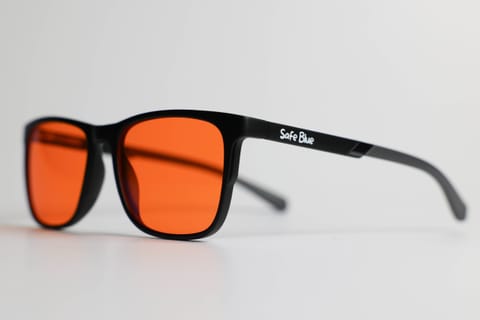
And the glasses? They can be part of this set as an accessory for evening visual comfort, chosen by many for the softer sensation they give with certain screens. But they should be added knowing that they are not the main lever and that we cannot promise effects on sleep. Lenses such as SAFEBLUE Classic — orange, blocking 99% of blue light between 400 and 500 nm and with a cutoff at 530 nm — measurably lower the blue component reaching the eye; what they do is a physical fact, not a guarantee of sleep.
Morning light counts as much as evening darkness
There is a lot of talk about limiting evening blue light, but it is easy to forget the other half of the mechanism: exposure to intense light during the day, and in particular in the morning. For the body clock, the two things work together.
Intense morning light — ideally natural light, outdoors — is a powerful signal that helps synchronise the circadian rhythm and “anchor” the day. Those who get little light during the day, perhaps staying in enclosed and dimly lit spaces, tend to have a less defined internal clock, and this can make it harder to fall asleep in the evening and wake up in the morning. In other words, a good night rhythm starts with good daytime exposure.
This overturns a widespread idea: blue light is not “the enemy” to always eliminate. During the day it is an ally of the rhythm. A short exposure to natural light in the early hours, a break outdoors, a desk near a window: these are free measures that, for the rhythms, make more sense than any evening accessory. The problem, once again, is the wrong timing — a lot of light in the evening, little during the day — not blue light as such.
Individual differences: chronotypes and sensitivity
Another reason not to promise the same effects for everyone is that people react to evening light differently. Two factors matter in particular.
The first is the chronotype, that is, the natural tendency to be a “lark” (awake and active early) or an “owl” (more awake in the evening). Evening chronotypes tend to fall asleep later and may be more sensitive to the effects of evening light in delaying the clock. It is not a flaw, it is biological variability: the same evening habit can weigh differently on different people.
The second is individual sensitivity to light. Studies show that the amount of melatonin suppression at the same light level varies quite a lot from person to person, sometimes considerably. This means the same dose of evening light can have a marked effect on someone and a modest one on someone else. It is one of the reasons it is impossible to promise a precise result to anyone: too many individual variables come into play.
There is also age. As agencies such as ANSES note, children have eyes that let more blue light through than adults’, and this makes them potentially more sensitive to evening exposure. For them, limiting screens and intense light in the hours before sleep is a particularly sensible measure, to be shared in any case with a paediatrician.
A reasonable evening routine
Putting the data together, you can sketch out an evening routine that makes sense without promising miracles. The underlying idea is simple: in the evening, less light and less blue; during the day, more light.
In the hours before sleep, lower the brightness of rooms and devices: dim light weighs far less than intense light. Turn on the warm-tone modes on phone and computer, which lower the intensity of the blue light emitted at no cost. Cut screen use in the last hour, especially for very stimulating content, and keep sleep hours as regular as possible, because regularity is one of the most strongly supported factors. If you love watching something in the evening, choose soft lighting in the room and keep the device at moderate brightness.
In this picture, filtering glasses can come in as an additional piece for evening visual comfort, if you like the sensation, but they remain the last item on the list, not the first. The honest hierarchy is clear: first intensity and timing of light, then habits, then perhaps an accessory. To promise that a pair of glasses replaces everything else would be dishonest, and we will not do it.
Frequently asked questions
Does blue light really make sleep worse?
Studies show that exposure to intense light rich in blue in the evening can suppress melatonin and delay the body clock, making it harder to fall asleep. The effect depends on intensity, duration and timing. It is evening light in general that counts, not just screens.
Will blue light glasses make me sleep better?
We cannot promise it, and be wary of those who do. The specific studies on glasses are few and weak, and the 2023 Cochrane review found no strong evidence of a benefit on sleep. They can be liked as an evening accessory, but they are not a demonstrated way to sleep better.
How long before sleep should I limit screens?
The most common guidance talks about the last hour or two before bed. More than a rigid rule, what counts is lowering the intensity of the light and the stimulation in that window. Even lowering the brightness and turning on warm tones helps more than people think.
Is melatonin in tablets better than glasses?
They are different things, and any supplement or substance should be discussed with a doctor, not chosen on your own on the basis of an article. Here we only talk about light and habits. For any persistent sleep disorder the right path is a professional.
Is night mode enough or do I also need glasses?
Night mode already lowers the blue light emitted by the screen, it is free and built in. Glasses add a physical filter that works on any light source. For many people it makes sense to start with the settings and consider glasses only as a next step, not as a substitute for habits.
Why is blue light not a problem for sleep during the day?
Because timing is everything. During the day, intense light, even rich in blue, is useful: it synchronises the clock and supports alertness. It only becomes counterproductive in the evening, when the body would expect darkness. Exposing yourself to natural light during the day can actually help the sleep-wake rhythm.
Are children more sensitive to evening blue light?
Yes, agencies such as ANSES note greater sensitivity in children, whose eyes let more blue light through. For them, limiting screens and intense light in the evening is particularly sensible. Any specific choice should be shared with a paediatrician or eye doctor.
What exactly does Cochrane say about glasses and sleep?
The 2023 Cochrane review examined the available studies on blue light filtering lenses and found no strong evidence of benefits, including those on sleep. It also noted that the studies were small and short. It is a position of caution, not a definitive rejection.
Do home light bulbs also affect sleep?
Yes, it is not just screens that count. Evening household lighting, especially if intense and cool-toned, contributes to overall exposure. This is why lowering the lights and preferring warm tones in the hours before sleep makes as much sense as managing devices. It is the total amount of evening light that weighs, not a single source.
Is watching TV in the evening a problem for sleep?
It depends on distance, brightness and timing. A television is usually watched from farther away than a phone, but it remains a source of evening light that adds to the others. Keeping the room softly lit, moderating the brightness and not pushing viewing into the late night are reasonable measures, more so than the type of screen itself.
In short
On the link between blue light and sleep, science is clear on one thing and cautious on another. It is clear that evening light rich in blue can suppress melatonin and delay the body clock, making it harder to fall asleep: studies like those of Cajochen and Chang show it. It is uncertain, by contrast, whether wearing filtering glasses makes sleep better, because the specific studies are few and weak and the Cochrane review does not consider them strong evidence.
The practical consequence is simple and honest: for the evening, the levers with the most support are lowering the intensity of light, turning on the warm tones and sorting out habits. Glasses can be a pleasant accessory for evening visual comfort, not a promise of sleep. If you want to carry on, read do blue light glasses work for the full picture, or what blue light is for the basic physics.
Sources
- Harvard Health Publishing — Blue light has a dark side
- Chang et al. (2014) — Evening use of light-emitting eReaders negatively affects sleep, circadian timing, and next-morning alertness, PNAS
- Cajochen et al. (2011) — Evening exposure to a LED-backlit computer screen affects circadian physiology and cognitive performance
- Shechter et al. (2018) — Blocking nocturnal blue light for insomnia: a randomized controlled trial
- Cochrane Review — Singh et al. (2023)
This article is for information only and does not constitute medical advice. See a qualified optometrist for any vision concerns. SAFEBLUE is a visual comfort accessory, not a medical device.
Related articles
What is blue light? Spectrum, wavelengths and sources
What is blue light, explained simply: the visible spectrum, wavelengths, why 400–530 nm, natural and artificial sources. A clear and honest guide.
Effects of blue light on the eyes: what is documented
Effects of blue light on the eyes: what the research says and what it does not, acute and chronic exposure, screen complaints. A careful guide, no alarmism.
Do blue light glasses work? What the research says
Do blue light filtering glasses work? The honest answer: what the research says, what is debated and when they make sense. No inflated promises.
Night Mode vs Glasses: What Actually Filters?
Night Shift, Night Light and f.lux shift the white balance; glasses filter the whole field of vision. Measurements, limits and how to combine them.