Watching TV Shows at Night: Eyes, Settings, Habits
Binge-watching in a dark room: OLED vs LCD, cinema mode, viewing distance, ambient light and when filtering glasses actually make sense.
· 15 min read
The episode ends, the credits roll, the “next episode” countdown ticks down relentlessly and you, of course, do not stop it. It is 23:40, the room is dark, the telly is the only light source, and your eyes — perfectly fine at 21:00 — now sting, water a little and focus the subtitles a beat late. The alarm is set for 7.
Evening binge-watching is one of the most universal habits of modern life, and one of the least optimised: we spend weeks choosing the TV and zero minutes sorting out the conditions we watch it in. Yet it is precisely there — in the contrast between a lit screen and a dark room, in the distance from the sofa, in the picture settings and in the time of night — that almost all the comfort of an evening in front of a series is decided.
In this article we line up what happens to your eyes when you watch TV in the dark (reassuring spoiler: no damage, on ophthalmologists’ word), whether OLED or LCD changes anything on the blue light front, what viewing distance makes sense, which TV settings are worth the trouble — from cinema mode to built-in blue light filters — and finally where, honestly, filtering glasses fit in: less where you expect (the TV three metres away), more where you were not thinking (the tablet under the covers for “one last episode”).
What happens to your eyes when you watch TV in the dark
Let us clear the field of the age-old fear, the granny one (“don’t watch TV in the dark, you’ll ruin your eyes”): according to the American Academy of Ophthalmology there is no evidence that watching screens — even in the dark — causes permanent damage to your sight. What total darkness does produce is discomfort, and it is discomfort explainable in three mechanisms:
- Extreme contrast. In a dark room the pupil dilates to adapt to the darkness, but the screen is an intense light source right in the centre of your visual field: the eye is forced into a continuous compromise between two opposite conditions. The dark and bright scenes that alternate (think of a horror series or an episode with many night-time exteriors) turn this compromise into a constant tug-of-war.
- Reduced blinking. As with any screen that captures attention, we blink far less than usual — the mechanism the AAO points to as the main driver of screen discomfort. Three episodes in a row is a good two hours of tear film put to the test, and that dry, “gritty” feeling at the end of the evening is born there.
- An evening crowd of light. The TV, the phone you check during the slow dialogue (do not deny it), the cold light in the kitchen: the average evening is a bombardment of light signals in exactly the hours when the body should be receiving the opposite message. We come back to this later, because it is the point with the most concrete implications.
The fix for the first problem is as old as home cinema and costs very little: a soft ambient light behind or beside the TV (so-called bias lighting). A simple warm, dim lamp behind the screen reduces the contrast jump without reflecting on the panel, and makes dark scenes paradoxically more readable. If you want the refined version: warm temperature (2700 K or less) and intensity around 10–20% of the screen’s brightness.
OLED or LCD: does anything change for blue light?
A question from videophile forums: for the eyes, is OLED or LCD better? The short answer: the differences exist but are secondary to brightness, settings and timing.
A few factual elements. LCD panels are backlit by LEDs that typically have a blue emission peak (around 450 nm) used to generate white light; OLEDs generate light pixel by pixel and, especially in dark scenes, emit far less light overall — a night scene on OLED lights up the room (and your retinas) much less than on an LCD with the backlight running at full power. On the other hand, an OLED showing a bright daytime scene also emits plenty of blue component: the panel chemistry counts less than the content and the brightness you have set.
The practical hierarchy, then, is this:
- the brightness you set counts more than the technology: a TV at 100% backlight in a dark room is excessive on any panel; in the evening, at home, much lower values are more than enough;
- the content counts more than the technology: two hours of bright, light scenes is more total light than two hours of noir, on any screen;
- the time counts most of all: the same dose of light received at 15:00 and at 23:30 means very different things to your internal clock.
For those who want the technical detail on the emission spectra of the two panel types, we have a dedicated comparison: OLED vs LCD and blue light. But if you remember one thing only: you do not need to change TV, you need to set it up well. Next section.
Viewing distance: is the sofa in the right place?
The distance from the television is one of the most underrated parameters of evening comfort — and one of the rare bits of good news in this article: the TV is almost always the most “restful” screen in the house, precisely because it is far away. At three metres, the focusing muscles work in far more relaxed conditions than at the 30 cm of a smartphone.
The practical references used by people who design rooms and home theatres:
- for a 4K TV, a distance of roughly 1.5 times the diagonal of the screen is the balance point between immersion and comfort: for a 55” (140 cm) we are talking about roughly 2.1 metres, for a 65” about 2.5;
- closer than that and the image gains immersion but forces the eyes into constant wide movements (and you see the pixel structure on non-4K content); much further and you tend to raise the brightness to compensate for the loss of impact — a vicious circle;
- the right height: centre of the screen at eye level when seated, or slightly below. The TV above the fireplace, however scenic, forces neck and gaze upward for hours;
- mind the reflections: windows and lamps facing the screen overlap the image and force the eye to “edge them out” continuously. Ambient light goes behind or beside the TV, never in front.
And here is the sore note: all this balance collapses when the series continues on the tablet or phone in bed. Same series, same hour, but distance halved or worse, screen a few centimetres from your face, often in total darkness. It is the visually most demanding moment of the whole evening — and we return to it in the glasses section, because that is where they make the most sense.
The TV settings worth the trouble
Five minutes in the TV menu are worth more than many accessories. Here is what to adjust, in order of impact:
- Picture mode: Cinema or Filmmaker Mode. The “Standard”, “Dynamic” or “Vivid” modes on showroom televisions blast brightness and cold tints to grab you in the shop. The Cinema/Filmmaker modes use a warmer colour temperature (the reference standard D65, often perceived as “yellowish” for the first two days) and a more realistic brightness: an image truer to the intentions of whoever shot it, and less cold light in your face. After a week, the other modes will look like an open fridge.
- Brightness/backlight suited to the evening. Many TVs have an ambient light sensor or programmable day/night profiles: use them. In an evening room with bias lighting, the backlight can come down a long way without losing readability.
- Built-in blue light reduction. Many recent televisions have a “visual comfort” or “blue light reduction” mode that warms the colour temperature in the evening hours, like the night mode on phones and computers. It costs nothing to turn on; the limit is the same as software filters — it acts only on that screen, not on the rest of the room, and to avoid wrecking the colours it filters gently. We compared software filters and physical lenses in night mode vs glasses.
- Subtitles and sharpness. If you squint to read the subtitles, enlarge them in the streaming app’s settings: it is a second of menu against hours of micro-effort. And turn off aggressive artificial “sharpness”, which adds artefacts more than detail.
- Turn off the automatic loop. It is not a picture setting, but it is the setting that decides what time the evening ends: disabling autoplay of the next episode is the single most impactful gesture in the whole menu. The 5-second countdown is designed to win against your willpower at 23:40; do not even give it the chance to start.
The real question: evening screens and the internal clock
We come to the point that separates the evening binge from the Sunday-afternoon one: the time. As Harvard Health explains, evening light — and in particular the blue component, around 400–500 nm — delays melatonin production and shifts the circadian rhythm; in the experiments cited, blue light suppressed melatonin for about twice as long as green light at equal intensity, with a phase shift of about 3 hours against 1.5.
What does that mean for your series marathon? That the bill for the evening is paid less by the eyes (which will be perfectly fine in the morning) than by falling asleep: arriving at midnight after three hours of intense light and high-tension plots means presenting yourself to bed with an internal clock convinced it is still afternoon. Harvard Health suggests avoiding bright screens in the 2–3 hours before sleep — advice as solid as it is, let us admit, incompatible with the very existence of TV series.
The pragmatic version, for those who will not negotiate away the evening in front of the TV:
- shift what you can: the “heavy” episode at 21:00, not at midnight; the last stretch of the evening at low lights and calmer content;
- reduce the dose: cinema mode, backlight down, bias lighting on — everything covered above reduces the total amount of light in the evening;
- filter the band that matters: and this is where orange lenses come in, which we discuss now. The full melatonin-light mechanism is explained in blue light and sleep.
Where filtering glasses (honestly) fit in
Let us first say what they do not do, because on this the data are clear: the 2023 Cochrane review on blue-light filtering glasses found no demonstrated benefit for short-term visual fatigue, and the effects on sleep in the available studies remain uncertain. If your eyes sting at the end of the evening, the better-founded answers are in the earlier sections: ambient light, blinking, breaks between episodes, TV settings.
What an orange lens does is — again — a physical fact: it screens the blue band from everything you look at, whatever the source. And this is where the geometry of your evening decides how much sense it makes:
- TV three metres away in a well-arranged room: the screen occupies a small portion of the visual field, cinema mode and low backlight have already cut the dose of light; the filter adds relatively little. If your evening is all there, sorting out the settings delivers more than the accessory.
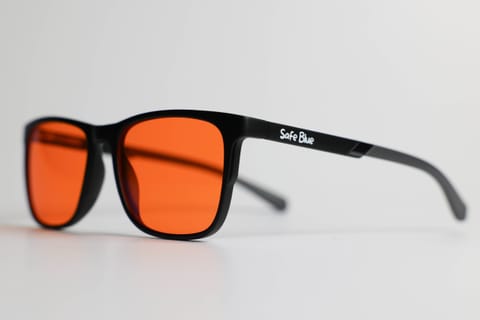
- Tablet or phone up close, perhaps in bed: screen at 30 cm, visual field dominated by the display, often darkness all around, and the device’s night mode filtering only partly. It is the scenario where a physical lens makes the most sense: it covers the whole visual field, filters regardless of the app or device, and the sharp cutoff at 530 nm does what no software filter dares to do so as not to wreck the colours. For those who end the evening this way, the SAFEBLUE Classic — blocking 99% between 400 and 500 nm, 65% visible transmission, €49.90 with a 30-day return — is designed exactly for those final hours.
- A mixed evening (TV + phone during + tablet after): the most common case, and the most honest answer is the combination: TV settings sorted once and for all, and glasses worn from the start of the evening onward, so the whole evening dose — TV, phone, hallway ceiling light — passes through the same filter.
A warning from series lovers: with an orange lens the photography of the show changes — the night-time blues of a dark episode go darker, the colour grading is no longer what the director intended. If visual fidelity is part of the pleasure for you, one solution is to watch the “important” episode without glasses at the start of the evening and put them on for the rest. What the world looks like through the lens we describe in do orange lenses tint everything?.
The typical evening, sorted
Let us sum it all up in a checklist to apply tonight:
- Once only: Cinema/Filmmaker mode on; evening profile or brightness sensor configured; the TV’s blue light reduction scheduled; subtitles at a comfortable size; autoplay off; warm lamp behind the TV; sofa at ~1.5 diagonals from the screen.
- Every evening: house lights low and warm from dinner onward; the heavy episode early, lighter content after; a real break between episodes (stand up, look into the distance, drink a glass of water — your eyes blink only if you let them); phone away from the sofa if you can; filtering glasses on if the evening continues up close on a tablet or phone.
- Last episode: decided before you start, not during the countdown. And the bedroom stays a screen-free zone: the next episode will still be there tomorrow, your circadian rhythm tonight will not.
Frequently asked questions
Does watching TV in the dark ruin your eyes?
No: according to the American Academy of Ophthalmology there is no evidence that screens cause permanent damage to your sight, even in the dark. Total darkness does increase discomfort because of the extreme contrast between screen and surroundings: a soft, warm light behind the TV (bias lighting) is the simple, cheap fix.
Is OLED or LCD better for someone who watches a lot of series in the evening?
For evening comfort the differences between technologies count less than the brightness you set, the picture mode and the time. OLEDs emit less light in dark scenes, LCDs have a backlight with a blue peak, but any TV in Cinema mode with adequate backlight beats a top-end TV in Dynamic mode at 100%.
Is the TV’s “blue light reduction” mode enough?
It is useful and free, so turn it on. Its limits: it filters gently so as not to wreck the colours, and it acts only on the TV — not on the phone you use during the adverts nor on the ceiling light. It is one piece, not the complete answer.
How far should I sit from the TV?
A practical reference for 4K TVs is about 1.5 times the diagonal: 2.1 metres for a 55”, 2.5 for a 65”. Height matters too (centre of the screen at eye level when seated) and the absence of frontal reflections. If you read the subtitles squinting, enlarge them first, then move the sofa closer if needed.
Why do I have dry eyes after three episodes?
Because in front of an engaging screen blinking collapses, and in two or three hours the tear film suffers. Real breaks between episodes, a few voluntary blinks and a room that is not completely dark are the immediate countermeasures. If the dryness is frequent even away from the sofa, talk to an optometrist.
Are blue light glasses any use for watching TV?
For a distant, well-set TV, the filter’s impact is limited: the screen occupies a small part of the visual field and the settings already do a lot. They make more sense when you watch up close — tablet or phone — or as a “total” filter for the evening, covering screens and lighting together. On the general effectiveness of the category, the 2023 Cochrane review advises caution: treat them as comfort, not as a necessity.
Can watching series until late make it hard to fall asleep?
Evening light, especially the blue component, delays melatonin production — Harvard Health documents effects about twice those of green light at equal intensity — and high-tension content adds mental arousal. A heavy episode early, low lights, a reduced dose of light and a firm stop before midnight are the main levers.
Is autoplay really a problem?
For the eyes and for the timing, yes: it turns a conscious decision (“shall I watch another episode?”) into an automatic default. Disabling it is the most effective way to give the evening an end point back — and it is free, which makes it the best “binge-watching accessory” in this article.
In short
A series evening that is comfortable for the eyes does not require a new TV: it requires a room that is not dark (bias lighting), Cinema mode, reduced evening backlight, the right distance from the sofa, breaks between episodes and an end time decided before the countdown. The most serious issue with the evening binge is not your sight — the AAO is reassuring on damage — but the “it is still daytime” signal that hours of light send to your internal clock until midnight. There the hierarchy is: less light, warmer, earlier; and for those who end the evening with the tablet thirty centimetres from their nose, an orange lens like the SAFEBLUE Classic is the physical piece that filters everything else. To work out where it fits in your routine, start again from when to wear blue light glasses — and happy viewing, in moderation.
Sources
This article is for information only and does not constitute medical advice. See a qualified optometrist for any vision concerns. SAFEBLUE is a visual comfort accessory, not a medical device.
Related articles
OLED vs LCD: Which Emits More Blue Light?
Emission spectra, the LED backlight's blue peak, the role of brightness and colour temperature: the technical OLED vs LCD comparison, PWM included.
Blue light and sleep: melatonin, circadian rhythm, data
Blue light and sleep: what studies say about melatonin and the circadian rhythm, the effect of evening light and why glasses are not a promise of sleep.
When to wear blue light glasses: a guide by time of day
Evening yes, daytime it depends, never night driving: a practical guide to when it makes sense to wear blue light glasses, with routines and examples.
Night Mode vs Glasses: What Actually Filters?
Night Shift, Night Light and f.lux shift the white balance; glasses filter the whole field of vision. Measurements, limits and how to combine them.