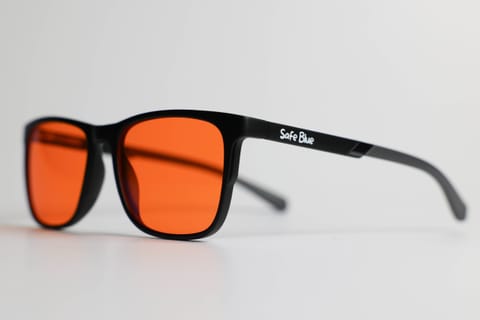
Do orange lenses make everything look orange?
Yes, there's a warm cast. But your visual system adapts: when you stop noticing it, when it stays a problem and when it doesn't. The honest answer.
· 13 min read
Let’s put the answer on the table straight away, because everything else you read here will be more useful if we start from honesty: yes, an orange lens introduces a warm cast, and for the first few minutes you’ll see everything shifted towards amber. Whites turn cream, blues go flat, the sky through a window looks almost grey. Anyone who tells you a lens that blocks 99% of blue light “doesn’t change the colours” either doesn’t know what they’re talking about or is hoping you won’t notice.
That said, the phrase “makes everything look orange” is true at second zero and becomes progressively false over the minutes and hours that follow. The reason is one of the most studied phenomena in human vision: chromatic adaptation, the visual system’s ability to recalibrate what it considers “white” according to the dominant illumination. It’s the same mechanism by which a white sheet of paper looks white both under the sun and under a yellow bulb, even though the light striking it is physically very different.
In this article we look the phenomenon in the eye without playing it down: why the cast is there and is physical, how and how quickly the brain “subtracts” it, when this adaptation works perfectly (the vast majority of uses) and when instead it isn’t enough and the orange lens becomes the wrong tool (colour work). No hype, no tricks: just what actually happens to your eyes.
Why the cast is there (and is unavoidable)
The physics here leaves no room. An orange lens filters because a pigment absorbs the short wavelengths — the blue and part of the blue-green. But “removing the blue from a scene” and “tinting the scene orange” are, for the eye, exactly the same operation: the light reaching the retina is depleted of its blue component, and light without blue is, by definition, warm.
This is why there can be no lens that blocks 99% of blue and keeps colours neutral: it would be like asking for a filter that removes the sugar from a coffee while leaving it just as sweet. The more effective the lens in the 400–530 nm band, the more pronounced the cast. It’s the fundamental trade-off we analyse in detail in orange vs clear lenses: filtration on one side, colour fidelity on the other, and no product can maximise both.
So the right question isn’t “does the lens make things look orange?” — the answer is yes, always, from a physical standpoint. The right question is: after how long do I stop noticing it, and in the cases where I do notice, is it a problem? To answer that, you need to understand the machine you have behind your eyes.
Chromatic adaptation: how the brain “removes” the orange
The human visual system doesn’t measure colours in absolute terms: it interprets them. The phenomenon we care about is called colour constancy, and it’s what lets you recognise an apple as red both at midday and at sunset, when the ambient light is completely different. The brain estimates the dominant illumination of the scene and “subtracts” it, to reconstruct the intrinsic colour of objects.
When you wear an orange lens, from the brain’s point of view it’s exactly as if the whole world were lit by a very warm light. And the visual system does what it has learned to do over hundreds of thousands of years of sunsets and campfires: it recalibrates the white point. After a few minutes, what looked cream at first looks white again to you; colours “reopen”; the scene normalises. The physical cast is still entirely there — a spectrophotometer would measure it as identical — but your perception has largely cancelled it.
Two components of adaptation have been measured in the lab. There’s a fast component, on the order of tens of milliseconds up to a few seconds, that reacts almost immediately; and a slow component, with a half-time of roughly 10–30 seconds and a tail that extends over many minutes. Translated into real experience: the bulk of adaptation happens in the first 1–2 minutes, the fine-tuning continues for 10–20 minutes, and after half an hour the cast is mostly out of conscious perception.
There’s also a surprising, well-documented detail. The study by Weiss, Witzel and Gegenfurtner (i-Perception, 2017) showed that the human visual system adapts asymmetrically along the yellow-blue axis: we adapt particularly well to bluish illumination (a “blue bias”, probably a legacy of adapting to daylight and the sky), and slightly less completely towards yellow-orange. This means adaptation to an orange lens is real and robust, but in certain conditions it can remain a touch incomplete compared with what we’d manage under a cool cast. It’s a technical observation, not a flaw in the lens: it only explains why some people stay a little more sensitive to orange than others.
When you stop noticing it (most cases)
In the vast majority of uses where an orange lens makes sense, adaptation settles the matter in a few minutes. Here are the scenarios where the cast simply stops being a problem:
- Watching a series or a film in the evening. After the first few minutes the brain has recalibrated, and you follow the plot without thinking about colour. You’re not judging whether the actor’s skin tone is faithful: you’re watching a story. It’s the ideal scenario, which we discuss in watching TV shows at night.
- Reading and writing. Black text on a white background: adaptation makes the background “white” quickly, and legibility doesn’t suffer. If anything, many people find the amber page more restful in the evening — a usage preference, not a proven benefit.
- Non-competitive gaming. In most games what matters is contrast and reaction, not absolute colour fidelity. More in PC gaming glasses.
- Programming, working on spreadsheets, browsing. Activities where colour is functional (highlighted syntax stays distinguishable) but there’s no colour judgement to make. See glasses for programmers.
- Evening scrolling on a phone. The most common scenario of all, and the one where adaptation works best, because the visual field is small and uniform.
In all these cases a practical rule holds: after 5–10 minutes, if you ask yourself “am I still seeing orange?”, the honest answer for most people is “now that you mention it, a bit, but until a moment ago I wasn’t thinking about it.” And that’s exactly how it should work.
When it stays a problem (colour work)
Here adaptation won’t save you, and it has to be said with the same clarity we used to admit the cast. Chromatic adaptation recalibrates your perception, but it doesn’t bring back the physical information the lens has removed. If the blue light doesn’t reach your eyes, you can’t judge the blue of that scene, however well your brain has adapted. For certain jobs this is decisive:
- Graphics, photography, video editing, colour grading. If you’re deciding whether an image has a cast to correct, a white balance, the right saturation, you can’t do it through an orange lens. The filter falsifies exactly the information you need to judge. For people who do this for a living we have a dedicated guide: glasses for designers.
- Print and colour management. Matching screen to print requires a controlled, calibrated white point. A filter in front of your eyes makes the whole process meaningless.
- Professional colour selection. Fashion, interior design, dentistry, any field where you have to match or recognise colours precisely.
- Colour-based inspection and quality control. Where the decision depends on the exact hue of something.
In all these cases the orange lens isn’t “a bit annoying”: it’s the wrong tool for the task, in the same way you wouldn’t use a ruler to weigh something. The right answer isn’t to give up the filter, but to separate the moments: colour work by day without a filter (or with a light clear lens, which alters far less), the orange filter in the evening when colour judgement is no longer needed. It’s the setup we recommend to anyone who lives by colour.
One intermediate case deserves a note: people who work with colour by day but still want the filter in the evening for their own time at screens. For them the orange lens is perfectly fine — just don’t wear it during the hours when colour is the job.
Can the cast be reduced? The alternatives
If the warm cast bothers you more than average — it happens, people differ, and the asymmetric “blue bias” above plays a part — there are intermediate compromises, as long as you accept less filtration:
- Yellow lenses. They typically block 60–90% below 450 nm with a far gentler cast than orange. They let most of the 480–530 nm band through, so coverage is partial, but for anyone who can’t tolerate amber they’re a good middle ground.
- Clear filtering lenses. Cast almost nil, modest filtration (30–65% below 450 nm, often less at the real screen peak). It’s the right choice if colour fidelity matters more than filtration: the full comparison is in orange vs clear lenses.
- Software only (night mode). It shifts the screen’s white balance without altering the rest of the world around you, but it covers a single device and only partially. Pros and cons in night mode vs glasses.
The choice depends, once again, on how much filtration is worth to you against colour. There’s no universal answer: there’s yours.
The role of brightness and surroundings
A little-discussed aspect is that how strongly you perceive the cast depends not only on the lens, but also on how the space around you is lit. Chromatic adaptation works on the dominant illumination: if the scene you’re watching is uniform and sustained — the classic evening screen in a room with warm lights — the brain finds a stable reference to calibrate against, and the cast fades quickly. If instead you keep moving from a cool source to a warm one (say, you look at the screen, then out the window in broad daylight, then back at the screen), the visual system has to recalibrate at every switch and the cast keeps reasserting itself at each transition.
This is one of the reasons an orange lens “performs better” in the evening than during the day, beyond any circadian considerations. In the evening the environment tends to be warmer and more stable, adaptation settles once and holds; during the day, between bright windows and mixed sources, it’s called on to work continuously. This is also why anyone trying the lens for the first time in the middle of the afternoon by a window tends to judge it more “orange” than someone wearing it on the sofa in the evening: it isn’t the lens that’s different, it’s the context that makes adaptation more or less easy.
A practical tip for the first trial, then: wear the lens in the same context where you actually plan to use it — in the evening, in front of the screens you normally use, with the lights you have at home — and give the visual system its 10–15 minutes. Judging it in the first thirty seconds, under a light different from your usage, is the quickest way to form the wrong impression.
The cast and perceived brightness
Beyond colour, an orange lens also lowers the overall luminance of the scene: with visible transmission around 65%, roughly a third of the light doesn’t get through. This is a separate effect from the colour cast and should be assessed on its own. Most people, in the evening, find a slightly dimmer scene pleasant — a usage preference, not a proven effect — but anyone working in already dim spaces may find the reduction too much. In those cases the answer isn’t to change lens, but to raise the ambient lighting a little (with warm lights) to compensate, keeping comfort without giving up the filter.
It’s worth recalling that luminance and cast interact with adaptation in different ways: the cast is “subtracted” by the brain in a few minutes, whereas the brightness reduction stays perceptible longer, because the visual system adapts to light level on even slower timescales. It’s normal, then, that after chromatic adaptation the scene looks “the right colour but a bit softer”: it’s exactly what the physics of the lens predicts.
Frequently asked questions
After how long do I stop seeing orange?
The bulk of adaptation happens in the first 1–2 minutes; fine-tuning continues for 10–20 minutes. After half an hour the cast is largely out of conscious perception for most people. The physical cast stays unchanged: only how the brain interprets it changes.
Does the cast really disappear or is it my imagination?
It disappears from your perception, not from the physics. The visual system recalibrates the white point (colour constancy) and “subtracts” the dominant illumination. An instrument would measure the cast as identical at the first and last minute; it’s you who stops noticing it.
Why does everything look bluish when I take the glasses off?
It’s the after-effect of adaptation: the brain, used for minutes to the warm illumination, overcompensates for a moment when you return to normal light, making you perceive an excess of blue. It fades in a few seconds, and it’s direct proof that the adaptation was working.
Does everyone adapt the same way?
No. There’s individual variation, and studies show that adaptation along the yellow-blue axis is asymmetric: people tend to adapt better to cool casts than to warm ones. Some people therefore stay a little more sensitive to orange. If you’re one of them, a yellow or clear lens may be more comfortable.
Can I use the orange lens to read without colour problems?
Yes. For black text on white, adaptation normalises the background quickly and legibility doesn’t suffer. Many people actually find the amber page more pleasant in the evening; it’s a subjective preference, not a proven effect.
What about watching films or series where colour matters?
For enjoyment (taking in the story) there’s no problem after the first few minutes. If instead you’re the one having to judge the film’s colour fidelity — because you’re editing or grading it — then you’re into colour work, and the lens should come off during that activity.
Can the orange lens be used for driving?
No, and not because of the cast but because of the brightness: with visible transmission around 50–70% it doesn’t meet the requirements for night driving set out in standard EN ISO 12312-1, which calls for higher transmission and correct recognition of coloured signals.
Is there a way to filter blue with no cast at all?
Not with a high-efficiency physical filter: removing the blue means warming the scene, it’s unavoidable. The only way to reduce the cast is to reduce the filtration (yellow or clear lenses) or act at the source with software, accepting less coverage in exchange.
In short
Yes, the orange lens makes things look orange — for the first minute. Then chromatic adaptation kicks in, one of the best-documented mechanisms in human vision, and within a few minutes the brain recalibrates the white point until the cast becomes largely imperceptible. For evenings in front of screens — series, reading, gaming, scrolling — that means the cast isn’t a real problem: it’s a first-moments nuisance that dissolves on its own. The only area where it stays decisive is colour work, where the filter should simply come off during the task. If you want to check it for yourself, SAFEBLUE Classic blocks 99% of blue light between 400 and 500 nm with the warm cast typical of the category, costs €49.90 and can be returned within 30 days: ample time to live the adaptation in your own skin and decide whether you and the amber get along.
Sources
This article is for information only and does not constitute medical advice. See a qualified optometrist for any vision concerns. SAFEBLUE is a visual comfort accessory, not a medical device.
Related articles
Orange vs Clear Lens: The Real Differences
Transmission spectra, blocking percentages and colour rendering: the technical comparison between orange and clear lenses, to work out which suits you.
Night Mode vs Glasses: What Actually Filters?
Night Shift, Night Light and f.lux shift the white balance; glasses filter the whole field of vision. Measurements, limits and how to combine them.
Glasses for Designers: When (Not) to Use an Orange Lens
Glasses for designers: why an orange lens has no place in colour work, when it makes sense anyway, and the serious alternatives: a calibrated monitor and D65.
How to Choose Blue Light Glasses: Criteria and Data to Ask For
Blocking percentages per nm range, CR-39 or polycarbonate, visible transmission, CE and UV400: the concrete criteria for choosing blue light glasses.