How to Choose Blue Light Glasses: Criteria and Data to Ask For
Blocking percentages per nm range, CR-39 or polycarbonate, visible transmission, CE and UV400: the concrete criteria for choosing blue light glasses.
· 13 min read
Choosing a pair of blue light glasses should be simple: you look at how much they filter, you weigh up whether the colour trade-off is acceptable, you compare price and guarantees. In practice it has become hard, because the market has learned to sell without numbers: “blocks harmful blue light”, “latest-generation lenses”, “advanced technology” — phrases that allow no real comparison at all between a €12 product and a €120 one.
This guide flips the problem on its head: instead of telling you which glasses to buy, it gives you the six technical criteria with which to assess any pair, of any brand — including ours. Because yes, the transparency statement is needed here too: SAFEBLUE makes an orange-lens pair, so we are an interested party. Our commitment is that every criterion in this guide is objective and verifiable: if you apply it to our product and to our competitors’, the comparison still works, whoever wins for your use case.
The master rule, from which all the others follow: never buy filtering glasses from anyone who won’t show you the filtering data per wavelength range. Everything else — materials, certifications, comfort — comes after that minimum threshold of seriousness.
Criterion 1: blocking percentage per band (ALWAYS ask for the data)
Visible blue light occupies roughly the 400–500 nm band. It is not all the same: LED screens emit with a peak around 450–460 nm, while the 400–420 nm region (violet) weighs very little in the real emission of monitors and smartphones. A filtering claim only makes sense if it specifies how much is blocked and where.
The three forms a serious figure can take, in order of quality:
- The full transmission curve (spectrum): a graph showing, nanometre by nanometre, how much light passes through. It is the gold standard: it makes cheating impossible.
- Per-band percentages: for example “99% blocked between 400 and 500 nm, 85% between 500 and 530 nm”. Less granular than the curve, but honest and comparable.
- A single value declared at the screen peak: for example “65% at 450 nm”. The bare minimum that is still acceptable.
And the forms that should make you close the page:
- “Blocks blue light” with no numbers.
- “Blocks up to 99%” — the “up to” usually refers to 400 nm, where almost all lenses filter, including those that let 90% through at 450 nm.
- Percentages referring only to the 400–420/440 nm band, passed off as total filtering.
This criterion alone eliminates much of the budget market and some high-end products. That is deliberate: those who measure, publish; those who don’t publish probably haven’t measured. If you already own a pair and want to understand what they actually do, we have written a practical guide on how to test blue light glasses.
Criterion 2: visible light transmission (VLT)
The twin figure to filtering, almost always ignored: how much total visible light the lens lets through. It is called VLT (Visible Light Transmission) and it determines how comfortable the glasses are in real life.
- VLT 80–95%: clear or near-clear lenses. Maximum brightness comfort, minimal blue filtering.
- VLT 55–75%: well-designed amber and orange lenses. The room looks slightly warmer and a little less bright, but you can read, work and move around without trouble in normally lit interiors.
- VLT below 40–50%: very dark lenses, on the verge of sunglasses. Shading is maximal, but in dimly lit evening rooms vision becomes tiring, and the glasses end up in a drawer.
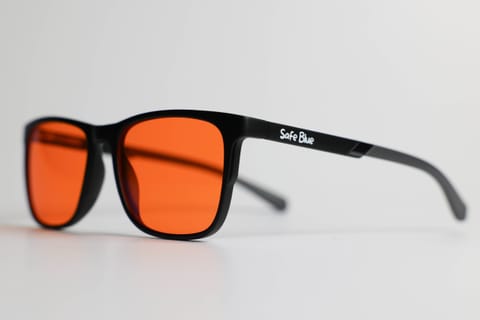
The critical point is the relationship between blue blocking and VLT: an excellent lens blocks almost everything in the 400–500 nm band while keeping a high VLT. It is the parameter we worked on hardest with SAFEBLUE Classic: 99% blocking (400–500 nm) and 85% (500–530 nm) with 65% VLT — enough light to wear the glasses for hours at home without the sense of wearing sunglasses. When you compare two orange lenses with similar blocking, VLT is the real differentiator of usability.
Criterion 3: lens material — CR-39 vs polycarbonate
The two materials that dominate serious eyewear, with different characteristics and no absolute winner:
| Characteristic | CR-39 (organic resin) | Polycarbonate (PC) |
|---|---|---|
| Optical quality (Abbe number) | Excellent (~58): minimal chromatic aberration | Good (~30): possible slight edge fringing |
| Impact resistance | Fair | Excellent (the material of sports eyewear) |
| Weight | Light | Very light (~20% less) |
| Scratch resistance | Good with a hard coating | Needs a hard coating (softer material) |
| UV filter | To be added | Intrinsic to the material |
| Cost | Contained | Contained (slightly higher for optical quality) |
In practical summary: for desk glasses, where impacts are rare and sharpness matters over hours of reading, CR-39 is often the better optical choice. Polycarbonate makes sense for anyone who wears glasses on the move, in sporting contexts, or for children. To be avoided at any price: the acrylic lenses (cheap PMMA) of multipacks, which combine optical distortion, scratch fragility and uneven tints.
A note on coatings: anti-reflective is real comfort for anyone working with light sources behind them, and a hard coating is all but mandatory on polycarbonate. Do check, though, that the blue light filter is in the lens material (pigment in the body) and not entrusted solely to a surface coating, which can degrade with use and cleaning.
Criterion 4: fit, weight and long-wear comfort
A technically perfect pair that hurts behind the ears after two hours is a pair you won’t wear. The concrete parameters to check:
- Total weight: under 30 grams for use over many hours; the best models sit between 18 and 28 g.
- Lens and bridge width: if you have a wide or narrow face, check the measurements (printed on the temple: e.g. 52□18-145). The wrong bridge dumps the weight onto the nose at a single point.
- Hinges: screwed, ideally with flex. The press-fit hinges of cheap products loosen within weeks.
- Lens coverage: for evening shading, light entering from the sides and the top counts too; frames that are too small leave bright “leaks”. Some brands oriented towards maximum blocking use wraparound shapes for this reason.
- Headphone compatibility: thin, flexible temples if you work or game with over-ear headphones.
Fit can’t be judged from a photo: that is why a real 30-day return window is not a marketing benefit but a selection criterion in its own right.
Criterion 5: certifications and standards — what they actually guarantee
A chapter full of misunderstandings, so let’s line up what each label means:
- CE marking: legally mandatory to sell glasses in the EU. It attests conformity to general safety requirements (non-toxic materials, no dangerous edges, basic optical requirements). It says nothing about blue light filtering. A CE pair can filter 99% or 2%: the marking doesn’t tell them apart.
- UV400: indicates that the lens blocks ultraviolet radiation up to 400 nm. It is a sensible requirement, by now cheap to meet, but it concerns UV, not visible blue light: it ends where blue light begins.
- EN ISO 12312-1: the standard for sunglasses and general-use filtering eyewear; it defines transmittance categories, optical quality requirements, robustness and traffic-signal recognition. A maker who declares conformity and states the filter category has done real tests.
- EN 170: the standard on ultraviolet filters for professional use; some makers cite it for the scale numbers of UV filters. Relevant for workplace contexts, less so for desk use.
A practical rule: CE and UV400 are the floor, not the ceiling. The right question is not “does it have CE certification?” but “beyond CE, what tests demonstrate the declared filtering?”. The decisive document remains the transmission spectrum, ideally from a third-party lab. And remember: filtering glasses of this category are not a medical device — be wary of anyone who implies otherwise.
Criterion 6: orange or clear — choose by your objective
The last criterion is the most personal, and fortunately also the simplest to decide. The two families serve different purposes:
Choose a clear or near-clear lens if:
- you use it in contexts where looks matter (office, clients, video calls);
- you work with colour (graphics, photo, video): any tint alters colour perception;
- modest filtering on violet is enough for you and you mainly want perceived comfort and an anti-reflective coating.
With one piece of awareness: the 2023 Cochrane review indicates that low-filtering clear lenses probably produce no measurable difference in short-term visual fatigue. Buy them knowing that.
Choose a high-blocking orange lens if:
- your objective is to genuinely shade the 400–530 nm band, particularly in the evening hours, when — as documented by Harvard Health — blue light interferes most with melatonin production;
- you accept that colours shift warm (the blue disappears: it is the physical price of the filtering);
- you use the glasses in contexts where the look of a coloured lens is not a problem (home, gaming, evening study).
ANSES, the French agency for health safety, recommends in general limiting exposure to screen blue light in the evening hours, especially for children and adolescents: the orange lens is one of the possible tools in that direction, alongside warm lighting and fewer screens at the end of the day. For the detailed comparison between the two families — colour rendering, use cases, limits — we have a dedicated guide: orange vs clear lens. And if the doubt is further upstream (“do I really need them?”), start from when to wear blue light glasses.
The final checklist before buying
An operational summary, to keep open while you compare products:
- Does the maker publish blocking percentages per nm band (or the full curve)? If not, discard.
- Does the figure cover the screen peak (450–460 nm), not just violet? If not, discard.
- Is the VLT declared, and is it compatible with your environment (≥55–60% for indoor use)?
- Is the lens optical-grade CR-39 or polycarbonate, with the filter in the body?
- Weight ≤30 g, measurements compatible with your face, screw hinges?
- CE marking and UV400 present, plus any references to EN ISO 12312-1?
- A return window of at least 30 days and a 2-year warranty, with a reachable seller?
- Is the price consistent with what it documents? (Our analysis of the price tiers gives you the reference points.)
Eight yeses: buy with confidence. One no on points 1–2: walk away, whatever the price.
Frequently asked questions
What is the “right” blocking percentage to look for?
It depends on the objective. For evening shading of the blue band it makes sense to aim for values ≥95% between 400 and 500 nm, with a cutoff around 520–550 nm. For daytime comfort with colours intact, any clear lens will stop at 10–25% on the 450 nm peak: accept that as the physical limit of the category, not as a defect of the individual product.
How do I know whether the maker is telling the truth about the percentages?
Three levels of verification: ask for the transmission curve or a third-party lab report; check the physical consistency (a “100% clear” lens that blocks 99% of blue is impossible); run a practical test with a pure-blue RGB screen, as we explain in the testing guide. A serious maker answers these requests; an evasive one disqualifies itself.
Better CR-39 or polycarbonate for working at the computer?
For mainly desk use, CR-39 offers the best optical quality (less chromatic aberration at the lens edges) and is the one we favour. Polycarbonate wins on impact resistance and weight: better for mobility, sport and children. Both are serious materials: the real dividing line is with cheap acrylic lenses, which are to be avoided.
Is CE marking enough as a quality guarantee?
No. CE is a minimum legal requirement attesting general product safety, not filtering performance. Use it as an elimination filter (a pair without CE is illegal in the EU market), not as a selection criterion. Filtering quality is judged only by the declared and verifiable spectral data.
What is the difference between UV400 and a blue light filter?
UV400 blocks ultraviolet up to 400 nm, invisible radiation present above all in sunlight. The blue light filter acts beyond 400 nm, on the visible blue light emitted by screens too. They are complementary on adjacent bands: a good filtering pair offers both, but one does not imply the other.
Are orange lenses fine for working with colour?
No, and it’s worth saying plainly: with a cutoff at ~530 nm, blue and part of green disappear from perception. For graphics, photography and video editing you need clear lenses or no lens, with a calibrated monitor. The orange lens is meant for sessions where colour fidelity doesn’t count: writing, code, reading, evening gaming.
How much should glasses weigh to be comfortable all day?
Below 30 grams, weight stops being a factor for most people; the better-made models sit between 18 and 28 g. Distribution matters too: a well-designed bridge and temples that don’t pinch are worth as much as the grams on the scale. That is why a 30-day return is part of the choice: comfort is verified by wearing, not by reading.
Are clip-on filters a good alternative to dedicated glasses?
Clip-ons (filtering lenses that attach over prescription glasses) solve a real problem for anyone wearing a correction who doesn’t want to pay for filtering prescription lenses. The assessment criteria stay identical: per-band blocking data, optical quality, weight added to the frame. The practical limits: extra weight on the nose during long sessions, reflections between the two lens surfaces, and a look that not everyone likes. For anyone who doesn’t wear prescription glasses, the dedicated filtering pair remains the most comfortable solution.
Should I choose different glasses for day and evening?
That is the ideal scenario for anyone wanting the most from both contexts: a clear or light amber lens by day (colours intact, neutral looks) and a high-blocking orange one for the 2–3 hours before bed. If you have to choose just one, start from the context where you spend the most hours in front of screens and from the issue you want to address first.
In short
Choosing blue light glasses well requires six checks: per-nm-band blocking data (the elimination criterion), visible transmission suited to the environment, a serious optical material (CR-39 or polycarbonate), comfort verifiable with a real return, certifications read for what they are, and the honest choice between clear and orange according to the objective — discreet comfort for the first, measurable shading for the second.
For our part, SAFEBLUE Classic’s numbers are public precisely so this checklist can interrogate them: 99% blocking across 400–500 nm, 85% across 500–530 nm, 65% VLT, CE and UV400, €49.90 with a 30-day return and a 2-year warranty. Apply all eight points to us — and apply them identically to everyone else. If every seller in this category were forced to answer the same checklist, the market would be a better place: in the meantime, the checklist is yours.
Sources
- ISO 12312-1:2022 — Eye and face protection, Sunglasses and related eyewear
- Cochrane Database of Systematic Reviews — Blue-light filtering spectacle lenses (2023)
- ANSES — LEDs & blue light
- American Academy of Ophthalmology — Are Blue Light Blocking Glasses Worth It?
- Harvard Health Publishing — Blue light has a dark side
This article is for information only and does not constitute medical advice. See a qualified optometrist for any vision concerns. SAFEBLUE is a visual comfort accessory, not a medical device.
Related articles
Orange vs Clear Lens: The Real Differences
Transmission spectra, blocking percentages and colour rendering: the technical comparison between orange and clear lenses, to work out which suits you.
How to Test Blue Light Glasses: Do They Really Filter?
Blue pen, spectrophotometer, RGB screen: the reliable tests and the misleading ones for checking how much your blue light glasses really filter.
Blue Light Glasses Price: Real Market Tiers in 2026
What blue light glasses actually cost: €10-20 on marketplaces, €30-60 mid-range, €70-100+ premium. What you really pay for, and the low-cost traps.
Best blue light glasses 2026: an honest market guide
An honest overview of the best blue light glasses in 2026: clear, amber and orange lenses compared, objective criteria and serious brands.