Blue Light Glasses Price: Real Market Tiers in 2026
What blue light glasses actually cost: €10-20 on marketplaces, €30-60 mid-range, €70-100+ premium. What you really pay for, and the low-cost traps.
· 13 min read
How much does a pair of blue light glasses cost? The honest answer is: anywhere from €8 to well over €150, for products that look identical to an untrained eye. It is one of the widest price spreads in the whole tech-accessory aisle, and that is no accident. Living inside that spread, side by side, you have glasses with transmission spectra measured in a laboratory and slabs of plastic with “anti blue light” screen-printed on the box and nothing else behind the claim.
This guide maps the real price tiers of the 2026 market and — more importantly — explains what genuinely changes from one tier to the next: lens materials, documented filtering percentages, certifications, sales channel. The aim is not to convince you that “spending more is always better” (it isn’t), nor that the cheap stuff is all rubbish (it isn’t), but to give you the tools to tell when a price is justified and when you are paying for marketing alone.
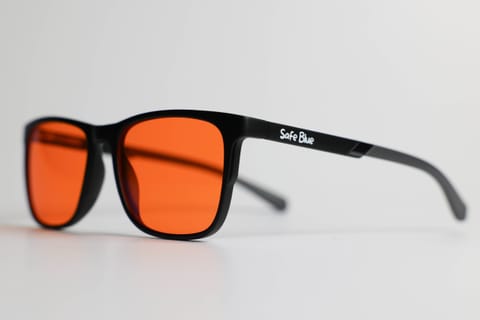
A word of transparency up front: SAFEBLUE sells an orange-lens pair for €49.90, so we have a direct interest in the mid-range. We say so straight away and, as always, we make up for it with numbers: every claim about performance and price is verifiable, and competitor prices are given as qualitative bands because they shift over time and across markets.
The price map: three tiers, three different markets
The market splits into three fairly distinct tiers. These are not just price points: they are three different ways of conceiving the product.
| Tier | Price | Where you buy it | What it typically contains |
|---|---|---|---|
| Budget | €8–25 | Marketplaces, pharmacies, chains | Acrylic or basic PC lens, generic undocumented filter, moulded frame |
| Mid-range | €30–60 | Specialist e-commerce | Quality CR-39 or PC lens, filtering declared per band, real returns and warranty |
| Premium | €70–150+ | International brands, opticians | Filter in the material, premium frames, prescription options, brand |
Let’s take them one at a time.
The €8–25 tier: budget marketplace and pharmacy glasses
This is the tier of marketplace multipacks (“3 pairs for €19.99”) and the filter-equipped “rest” glasses sold in pharmacies or budget optical chains. What the price buys you: an injection-moulded frame, acrylic or cheap polycarbonate lenses, a filter that in most cases acts only on extreme violet (400–420 nm), and some packaging.
What it almost never buys you: a transmission spectrum, a blocking percentage tied to a precise band, a documented optical quality check. That doesn’t make these glasses useless — a neutral pair with a UV400 filter and CE marking at €15 is a legitimate product — but it means you are buying blind. Practical tests, like the ones we describe in our DIY testing guide, show that many cheap clear lenses let through almost all of the blue light from screens.
The €30–60 tier: the specialist mid-range
Here the product changes character: no longer a generic accessory but a pair of glasses designed around the filter. In this tier it is reasonable to demand — and serious brands offer it — CR-39 or optical-grade polycarbonate lenses, filtering declared by nanometre range, CE marking, a UV400 filter, a 30-day return window and a 2-year warranty. This is where SAFEBLUE Classic sits (€49.90, 99% blocking across 400–500 nm and 85% across 500–530 nm, 65% visible light transmission), alongside some Pixel Eyewear models, roughly in the €50–80 range.
The ratio of measurable performance to price is, in this tier, the most favourable in the whole market: the lens figures can match premium, while the saving comes from solid but not luxury frames and from direct online distribution.
The €70–150+ tier: premium
Premium is paid for four reasons, some solid and some less so. The solid ones: a filter built into the body of the lens rather than applied as a surface coating (more durable), quality acetate frames with good hinges, the option of prescription lenses, more rigorous optical checks. The less solid ones: brand positioning and, for non-EU brands such as Bon Charge or Felix Gray, international shipping and customs that end up in the final price without improving the product. Gunnar occupies the lower end of this tier (roughly €60–120) with a documented filtering figure — 65% at 450 nm on the Amber lenses — which remains the reference point for the amber category.
For anyone with specific needs (prescription lenses, designer-eyewear looks, lab-certified total filtering) premium makes sense. For anyone after filtering performance alone, you often pay a premium that has nothing to do with the numbers.
What actually justifies the price differences
Let’s take a filtering pair apart into its real components.
1. The lens material
Acrylic lenses costing a few euros scratch easily and introduce perceptible optical distortion over long sessions. CR-39 (the standard organic resin of eyewear) offers sharpness and colour stability at a contained cost; polycarbonate adds impact resistance with a small optical trade-off. The industrial cost difference between an acrylic lens and a quality CR-39 one is a few euros a pair, but the difference in daily use is considerable. We go deeper into the comparison in the buyer’s guide.
2. The filter: pigment in the body vs coating
A filter can be obtained in two ways: by embedding the pigment in the body of the lens, or by applying a reflective coating to the surface. The first method is more expensive, more uniform and more durable; the second is cheaper but can degrade with scratches and aggressive cleaning. Many budget pairs use thin coatings that reflect a little violet (the typical bluish sheen) and not much else. It is one of the differences invisible to the naked eye that a spectrophotometer reveals at once.
3. The measured filtering (and who measures it)
Declaring “blocks 99% of blue light” costs nothing. Measuring it with a spectrophotometer, band by band, and publishing the curve costs time and money — and having the data verified by a third-party lab costs more still. The price of a serious product includes this characterisation work. When you compare two prices, always ask yourself: which of the two makers will show me the curve?
4. The certifications
CE marking is mandatory and in itself sets no one apart. But references to specific technical standards — such as EN ISO 12312-1 for the requirements of general-use filtering eyewear, or UV400 filter verification — involve real tests on transmittance, robustness and optical quality. A maker who cites the standards and shows the test reports is spending on compliance; one who simply prints the CE logo on the temple may have tested nothing beyond the legal minimum.
5. Frame, hinges, comfort
Metal screw hinges, flexible temples, weight under 30 grams, acetate rather than injected plastic: each of these adds a few euros of cost and hours of daily comfort. On an object that may sit on your nose for six hours a day, this is the part of the price you “feel” the most.
6. Channel, returns, warranty
A 30-day return window with shipping covered, a 2-year warranty actually honoured, support in your own language: all of this is included in the price of serious brands and absent from marketplace multipacks, where “returns” often mean shipping back to a foreign hub at your own expense.
The budget traps (and how to spot them)
The problem with budget products isn’t the low price: it’s the information asymmetry. Here are the recurring red flags, in order of severity:
- No per-band data. The wording “blocks blue light” with no percentage or nm range is red flag number one. If the figure is there but refers only to 400–420 nm, it is almost as empty: at those wavelengths even completely clear lenses filter “well”.
- The “pen test” included in the box. Many cheap kits include a violet pen-torch and a card that lights up: it only shows that the lens absorbs violet at ~405 nm, not that it filters blue at 450 nm where screens actually emit. We explain why in the testing guide.
- “Up to” percentages. “Blocks up to 90%” can legally describe a lens that blocks 90% at 400 nm and 5% at 460 nm.
- Photocopied reviews and throwaway brands. Labels that have existed for six months, appear only on marketplaces and change name every season will never stand behind a warranty.
- Lenses that promise everything. “100% clear AND blocks 99% of blue light” is physically impossible: blue light is part of the visible spectrum, and blocking nearly all of it necessarily means tinting the lens. On this point there are no exceptions, only false claims.
An honest note: the 2023 Cochrane review found that low-filtering clear lenses probably produce no measurable difference in short-term visual fatigue. This cuts the budget market in two: if you buy a cheap clear lens “to feel better in front of the PC”, the evidence is not on your side at any price. High-filtering lenses are a different product category, with a different rationale for use (evening shading of the blue band) — we discuss them in best blue light glasses.
How much it makes sense to spend, profile by profile
| Profile | Recommended tier | Why |
|---|---|---|
| Curious, wants to try | €10–25 | Low-risk experiment, low expectations |
| Screen worker 6–8 h/day | €30–60 | Documented numbers and comfort, no brand premium |
| Systematic evening use, filtering priority | €30–60 (orange) | High documented filtering already exists in the mid-range |
| Needs filtering prescription lenses | €70–150+ | Only premium (or the optician) offers prescriptions |
| Designer-eyewear looks | €70–150+ | Acetates and design cost money, and that’s fair enough |
The underlying logic: spend on the numbers and on comfort, not on the promises. A €45 pair with a published spectrum is worth more than a €120 pair that vaguely claims to “filter harmful blue light”. If you want to think in terms of cost per hour of use — which, for a screen worker, is the most sensible calculation — we have devoted a whole article to how much blue light glasses really cost.
Frequently asked questions
What is the right price for good-quality blue light glasses?
For non-prescription glasses with filtering documented per band, serious optical materials and a real warranty, the €30–60 tier already covers the best of measurable performance. Below €25 almost no product documents its own performance; above €70 you are mostly paying for premium frames, prescription lenses or brand. Exceptions exist in both directions, but this is the statistical map of the 2026 market.
Why do some blue light glasses cost only €10?
Because the industrial cost of a moulded frame with acrylic lenses and a generic coating is a few euros. The product can be honest as a neutral pair with a UV filter, but at that price there is no margin for spectral characterisation, optical quality control or after-sales support. A low price is not a scam in itself: it becomes one when paired with undocumented filtering claims.
Do expensive blue light glasses work better?
Not automatically. Price correlates with materials and finish, not necessarily with filtering: there are mid-range orange lenses that block more blue light than premium clear lenses, because the physics of the tint counts for more than the brand’s price. The only way to compare is to read the transmission curves. If a maker doesn’t publish them, their price — high or low — is missing its context.
How much does SAFEBLUE cost, and what does the price include?
SAFEBLUE Classic costs €49.90. The price includes the orange lens with a measured 99% block (400–500 nm) and 85% (500–530 nm), 65% visible light transmission, a 30-day return window, a 2-year warranty and free shipping over €80. We are biased by definition, so our advice stays the same as it is for everyone: compare these numbers with the others, not with their slogans.
Are pharmacy glasses with a blue light filter worth the price?
As “rest” glasses with a UV filter and CE marking, yes: €15–25 for a safe pair to keep in your bag is money honestly spent. As a blue light filtering tool, rarely: the tint is almost absent and performance in the 440–500 nm band is not declared. They are an entry point, not a destination.
Is it worth buying used or discounted blue light glasses?
On sale, yes, with one caution: check that the seller is the official channel and that returns and warranty remain valid. Used, it depends on the type of filter: if the filtering sits in a surface coating, scratches and wear may have compromised it in a way invisible to the naked eye. Lenses with pigment in the body age far better in this respect.
Do prescription lenses with a blue light filter cost much more?
Yes: a prescription almost always moves the product into the premium tier (roughly from €100 up at specialist brands, variable at the optician depending on the correction). For many users the cheapest combination remains a normal prescription pair plus contact lenses for the moments when you want to wear a non-prescription filtering pair on top.
Is it worth waiting for Black Friday and sales to buy?
Real discounts do exist, especially at international premium brands, where a seasonal 20–30% off brings the price back into mid-range territory. Two cautions: check the price history (a “discount” calculated on an inflated list price is a classic of the sector) and double-check that return conditions stay unchanged during promotions. In the mid-range, discounts are rarer because margins are already compressed: if you need the product now, waiting months to save €10 rarely pays off, given the cost-per-hour-of-use point above.
Does the price always include returns and warranty?
No, and it is one of the most concrete differences between tiers. Serious mid-range and premium brands offer a 30-day return window and a 2-year warranty (the statutory EU one for conformity defects applies regardless, but enforcing it against a non-EU marketplace seller is in practice nearly impossible). With budget marketplace products the return exists on paper but often at your own expense to foreign hubs.
In short
The price of blue light glasses tells three different stories: under €25 you buy an undocumented experiment, between €30 and €60 you buy verifiable numbers and comfort, above €70 you add finish, prescriptions or brand. The justified differences sit in materials, in-body filter, spectral characterisation and certifications; the less justified ones in marketing and import.
Our position in the market is declared: €49.90 for the highest filtering that physics allows with a lens still comfortable indoors (99% across 400–500 nm, 65% visible transmission). If you are weighing up a purchase, in any tier, bring one question with you: “will you show me the transmission curve?” It is the best filter there is — on the sellers, even before the light.
Sources
- Cochrane Database of Systematic Reviews — Blue-light filtering spectacle lenses (2023)
- ISO 12312-1:2022 — Eye and face protection, Sunglasses and related eyewear
- American Academy of Ophthalmology — Are Blue Light Blocking Glasses Worth It?
- GUNNAR Optiks — official site
- Pixel Eyewear — official site
- Bon Charge — official site
This article is for information only and does not constitute medical advice. See a qualified optometrist for any vision concerns. SAFEBLUE is a visual comfort accessory, not a medical device.
Related articles
How Much Do Blue Light Glasses Cost? Budget and Real Cost
Beyond the list price: cost per hour of use, comparison with other desk spending, and a realistic budget for anyone at a screen 8 hours a day.
How to Choose Blue Light Glasses: Criteria and Data to Ask For
Blocking percentages per nm range, CR-39 or polycarbonate, visible transmission, CE and UV400: the concrete criteria for choosing blue light glasses.
Best blue light glasses 2026: an honest market guide
An honest overview of the best blue light glasses in 2026: clear, amber and orange lenses compared, objective criteria and serious brands.
How to Test Blue Light Glasses: Do They Really Filter?
Blue pen, spectrophotometer, RGB screen: the reliable tests and the misleading ones for checking how much your blue light glasses really filter.