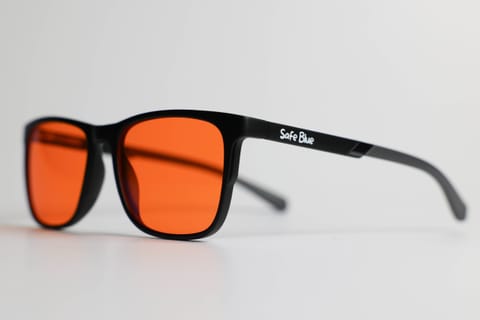
How to Test Blue Light Glasses: Do They Really Filter?
Blue pen, spectrophotometer, RGB screen: the reliable tests and the misleading ones for checking how much your blue light glasses really filter.
· 14 min read
You’ve bought (or are about to buy) a pair of “anti blue light” glasses and want to know whether they really filter. A more than legitimate question: in a market where “blue light blocking” is printed for free on any frame, the distance between what’s written on the box and what the lens physically does can be enormous. The good news is that light filtering is a measurable physical phenomenon, not a matter of opinion: it can be checked. The bad news is that the most widespread test — the famous “blue pen” included in many cheap kits — is also the most misleading one there is.
In this guide we line up the verification methods from weakest to most solid: what the pen test actually demonstrates, why the spectrophotometer is the only definitive judge, how to read a spec sheet without being fooled by “up to”, and how to build yourself in five minutes a home test with an RGB screen that, while it won’t give precise numbers, exposes the products that filter nothing.
Transparency note: SAFEBLUE makes orange-lens glasses, so on this topic we are an interested party — high-filtering products like ours come out well from the tests we’ll discuss, while many clear lenses don’t. It is a category advantage, not a moral merit: we declare it and explain the physics, so the judge remains you.
Why you need to test: the market’s asymmetry
The underlying problem is that blue light filtering is invisible to the naked eye at the moment of purchase. A clear lens that blocks 5% and one that blocks 25% look identical in the hand; even a lens with a bluish sheen on the surface — often sold as “proof” of the filter — can let through almost all the blue light from screens. The consumer has no way to check on the spot, and part of the market knows it.
Add that filtering claims are not subject to any specific mandatory verification: CE marking attests general safety requirements, not blocking percentages. Technical standards such as EN ISO 12312-1 define how to measure transmittance and classify filters, but declaring conformity is a maker’s choice. The result: claims cost nothing, measurements cost money, and in between sits the customer’s trust.
Hence the three questions of this guide: what you can check yourself, what you must demand from the maker, and how to tell a serious test from a market-stall trick.
The “blue pen test”: what it actually demonstrates (and what it doesn’t)
The kit is omnipresent in marketplace products: a pen-torch that emits violet light and a white card that lights up when you point it. The demonstration: you point the pen at the card and the card glows; you interpose the lens and the card stays dark. “See? It blocks blue light.”
The trick is in the wavelength. Those pens typically emit around 405 nm — on the border between violet and ultraviolet — and the card is fluorescent precisely at UV/violet. Blocking 405 nm is extremely easy: almost any lens with a decent UV400 filter manages it, including completely clear lenses that at 450 nm — where LED screens have their real emission peak — let through 80–90% of the light.
In other words: the pen test shows that the lens blocks extreme violet, that is, the part least relevant for someone spending evenings in front of a monitor. It is like testing an umbrella by spraying it with a mister: technically it’s water, but it isn’t the rain you bought it for.
What you can honestly conclude: if the lens fails the pen test, it doesn’t even filter violet — a complete fail. If it passes, you’ve learned almost nothing about the 440–500 nm band. It is a test with negative value only, and it should be handled as such.
The spectrophotometer: the only definitive test
The instrument that ends every argument is called a spectrophotometer: it measures, wavelength by wavelength, how much light passes through the lens. The result is the spectral transmission curve — a graph with nanometres on the horizontal axis (typically 280–780 nm) and the percentage of light transmitted on the vertical one.
From that curve you read every number that matters:
- the transmittance at 450–460 nm, the emission peak of LED screens;
- the average block per band (e.g. 400–500 nm), which sums up performance across the whole blue region;
- the cutoff, the wavelength below which transmission is practically nil;
- the VLT (total visible light transmission), which determines how dark the lens is and therefore how usable indoors.
It is the measurement done by optical labs, serious makers and the most rigorous independent reviewers. It is not within reach of DIY (a lab instrument costs thousands of euros), but you don’t need to own one: you need to demand that the seller has done the measurement and published it. A maker who declares per-band percentages without being able to show a curve or a test report is asking for trust on their word; one who publishes the spectrum exposes themselves to anyone’s verification — which is exactly the uncomfortable position an honest seller should want to be in.
Some brands do this: Gunnar, for example, declares a verifiable single value (65% blocking at 450 nm on the Amber lenses) and its own filtering scale. It is the minimum level of transparency that makes sense to reward with a purchase, as we explain in the buyer’s guide.
How to read a spec sheet without being fooled
When the documentation is there, it should be read carefully: even true numbers can be presented creatively. The four checks to run on any sheet:
- Which band does the percentage refer to? “Blocks 99% of blue light” referring to 400–420 nm is an almost empty statement: clear lenses filter well there too. The meaningful figure covers 400–500 nm, or at least declares the value at the 450 nm peak.
- Does it say “up to”? “Blocks up to 95%” describes the best point of the curve, usually the violet extreme. It is legal, it is true, and it is designed to make you understand something else.
- Is the VLT declared? A lens that blocks “everything” but has a VLT of 30% is effectively sunglasses: uncomfortable at home in the evening. Blocking and VLT must be read together; the ratio between the two is the real signature of a lens’s quality. We discuss it in the comparison between orange and clear lenses.
- Who did the measurement? Maker’s self-declaration, in-house lab or independent third-party lab? These are three levels of increasing reliability. A reference to standardised methods (EN ISO 12312-1) is a further sign of seriousness.
A sheet that passes these four checks is rare — and that is exactly the point: the rarity of serious documentation is the most useful piece of information this market gives you about itself.
The DIY test with an RGB screen
No spectrophotometer? Your monitor is a blue-light generator calibrated well enough for an honest qualitative test. The blue subpixels of an LCD or OLED screen emit with a peak around 450–460 nm: exactly the band you want to check.
The procedure, in five minutes:
- Open an image or page in solid pure blue (RGB 0, 0, 255) full-screen, with the monitor brightness high and the room lights low.
- Look at the screen without glasses: memorise the intensity of the blue.
- Interpose the lens between eye and screen (better than wearing it: this way you compare in/out of the lens in the same glance).
- Repeat with a pure green square (0, 255, 0) and a pure red one (255, 0, 0) as controls.
How to interpret the result:
- High-blocking orange lens: the blue square should appear almost black, drastically dimmed. The green will come out partly dimmed (it depends on the cutoff: with a cut at 530 nm, the blue-green portion goes dark), the red almost unchanged. If the blue stays vivid through a lens sold as “total blocking”, you have the proof of the problem.
- Amber lens: visibly dimmed blue but not dark; green and red barely touched.
- Clear lens: typically the blue appears just slightly less bright, or completely unchanged. That isn’t a flaw in your test: it’s the real performance of the product.
The limits, declared: it is a qualitative test, not a quantitative one. The eye adapts to brightness and can’t tell a 60% block from a 75% one; OLED and LCD screens have slightly different spectra; perception through a coloured lens is influenced by chromatic adaptation. The RGB test serves three crude but robust verdicts: “filters nothing”, “filters something”, “filters a great deal”. For precise numbers you go back to the spectrophotometer — or to the spec sheet of whoever used one.
An even simpler variant for the first screening: many sites show the classic blue circle on a black background. Same logic, same reading, same limits.
Why many clear lenses disappoint in tests
When a user runs the RGB test with their €80 clear glasses and sees the blue pass through almost intact, the typical reaction is to suspect they’ve bought a fake. Almost always the explanation is simpler and more uncomfortable: it’s the physics, not a scam.
Blue light is part of the visible spectrum. A lens that genuinely blocked 90% of it in the 400–500 nm band would absorb a substantial slice of the light you see, and would inevitably appear yellow or orange — because removing blue from white leaves yellow. An optically clear lens can therefore filter only modest fractions of blue: the reference literature, including the 2023 Cochrane review, places commercial clear lenses typically between 10% and 25% blocking around 450 nm. Not by chance, that same review, based largely on lenses of this type, found no short-term difference in visual fatigue compared with normal lenses — a result consistent with those numbers, which we discuss in detail in do blue light glasses work?.
This doesn’t make clear lenses useless in absolute terms: an anti-reflective coating, a UV filter and perceived comfort are real values for many users. But it means their place in filtering tests is structurally modest, and that any clear lens sold promising “near-total blue light blocking” is promising something the physics won’t allow. When a product disappoints in the RGB test, before blaming the individual seller, check the category: often the problem is the expectation built by the marketing, not the faulty piece.
Our numbers, put through the same tests
Consistency requires us to put our own data on the table too, with the usual caveat: we are biased. SAFEBLUE Classic fits an orange lens with a measured 99% block in the 400–500 nm band, 85% in the 500–530 nm band, a cutoff at 530 nm and 65% VLT.
Translated into the tests of this guide: the 405 nm pen goes dark (as on almost any lens, and indeed that isn’t the point); in the RGB test the blue square appears practically black and the green clearly dimmed up to the cutoff region; on the spectral curve, transmission stays close to zero below 500 nm. The flip side is declared with the same frankness: colours shift warm, and for colour work the lens is not suitable.
If you buy a pair from us, you can run the RGB test above within the 30-day return window: if the result doesn’t match what’s declared, the return exists exactly for that. It is the standard of verifiability we’d want to be normal across the whole market — and the reason this guide invites you to test any glasses, ours included.
Frequently asked questions
How do I know whether my blue light glasses work?
Three levels: the pen test (negative value only: if it fails, the lens doesn’t even filter violet), the RGB test with a pure-blue screen (a qualitative verdict on the band that counts, 450 nm), and the request to the maker for the measured transmission curve (the only quantitative figure). For a clear lens, expect visually modest results regardless: it’s the physical limit of the category.
Is the blue pen test reliable?
Only negatively. The pen emits around 405 nm (extreme violet), which almost all lenses with a decent UV filter block — including those that let through nearly all the blue at 450 nm. Passing the pen test doesn’t demonstrate useful filtering on screens; failing it shows the product filters nothing. The kits that include it as “proof of efficacy” exploit this ambiguity.
What is the transmission curve and where do I find it?
It is the graph, measured with a spectrophotometer, that shows the percentage of light transmitted by the lens at each wavelength. Serious makers publish it on the site or provide it on request, sometimes with third-party lab reports. If a seller doesn’t know what it is or can’t provide it, their declared percentages have no verifiable basis: handle them accordingly.
Can I run a reliable test with a smartphone?
Yes, as a qualitative test: open a pure-blue image (RGB 0,0,255) full-screen, brightness at maximum, and compare the view with and without the lens. Bear in mind that smartphone OLED screens have a slightly different spectrum from LCDs, but the blue peak stays in the 450–460 nm zone: to tell “filters nothing” from “filters a great deal” it is more than enough.
Why doesn’t my clear lens pass the blue-screen test?
Because it most likely filters 10–25% at 450 nm, a difference the eye struggles to perceive. It isn’t necessarily a counterfeit product: it’s the typical performance of the category, declared by honest makers and kept quiet by the others. If you were promised “near-total” filtering on a clear lens, the problem is the promise, not your test.
Are there labs where I can have my own glasses tested?
Yes: optical labs and accredited test institutes carry out spectral transmittance measurements, typically using standardised methods such as those of EN ISO 12312-1. For a private individual the cost rarely justifies itself relative to the price of the glasses; more realistic is to ask the maker for the existing test report, or to rely on independent reviews that publish measured spectra.
Are apps for measuring blue light reliable?
With great caution. Apps that use the smartphone’s brightness sensor or camera don’t measure the spectrum: they estimate. They can show you relative differences (with/without lens in front of the sensor) but not reliable per-band percentages. As a qualitative order of magnitude they are comparable to the visual RGB test; for the real numbers you need a spectrophotometer.
What is the difference between the blue sheen of a lens and a real filter?
The bluish sheen indicates a reflective coating that pushes back a small share of blue-violet light at the surface: dramatic-looking, but usually worth a few percentage points. Substantial filters work by absorption, with pigments in the body of the lens, and are recognisable by the tint (yellow, amber or orange) and by the numbers on the spec sheet. The sheen is an aesthetic clue, not a performance.
In short
Verifying blue light glasses is possible, provided you use the right tools in the right order: the pen test serves only to fail (405 nm is not the light of your screens), the home RGB test gives an honest qualitative verdict on the 450 nm band, and the transmission curve measured with a spectrophotometer remains the only document that turns promises into numbers. The market rule that follows is simple: buy from those who publish the spectra, be wary of those who attach pens.
And remember the physical constraint that explains most of the disappointments: a genuinely clear lens cannot block much of the blue — for that you need tinted lenses, with the colour trade-offs involved. Our numbers (99% across 400–500 nm, 65% VLT) are public and testable with everything you’ve read here, 30-day return included: if you fancy putting them to the test, the blue screen is one click away. To choose sensibly among all the alternatives on the market, start again from the full overview.
Sources
- Cochrane Database of Systematic Reviews — Blue-light filtering spectacle lenses (2023)
- ISO 12312-1:2022 — Eye and face protection, Sunglasses and related eyewear
- American Academy of Ophthalmology — Are Blue Light Blocking Glasses Worth It?
- Harvard Health Publishing — Blue light has a dark side
- GUNNAR Optiks — official site
This article is for information only and does not constitute medical advice. See a qualified optometrist for any vision concerns. SAFEBLUE is a visual comfort accessory, not a medical device.
Related articles
How to Choose Blue Light Glasses: Criteria and Data to Ask For
Blocking percentages per nm range, CR-39 or polycarbonate, visible transmission, CE and UV400: the concrete criteria for choosing blue light glasses.
Orange vs Clear Lens: The Real Differences
Transmission spectra, blocking percentages and colour rendering: the technical comparison between orange and clear lenses, to work out which suits you.
Do blue light glasses work? What the research says
Do blue light filtering glasses work? The honest answer: what the research says, what is debated and when they make sense. No inflated promises.
Best blue light glasses 2026: an honest market guide
An honest overview of the best blue light glasses in 2026: clear, amber and orange lenses compared, objective criteria and serious brands.