Orange vs Clear Lens: The Real Differences
Transmission spectra, blocking percentages and colour rendering: the technical comparison between orange and clear lenses, to work out which suits you.
· 13 min read
If you’re weighing up a pair of glasses with a blue light filter, sooner or later you reach the fork in the road: clear lens or orange lens? The two options are often presented as variants of the same thing, but from a physical standpoint they are very different products, with filtering percentages that can differ by as much as tenfold on the wavelengths that matter.
The short answer: a clear lens with a filter lets through most of the blue light and in return doesn’t alter colours; an orange lens blocks nearly all the blue light (and part of the blue-green) and in return introduces a visible warm cast. No lens does both: it is a physical trade-off, not a limit of whoever makes them.
In this article we line up the numbers: how the two technologies work, what the typical transmission spectra are, how much each lens really blocks in the 400–450 nm, 450–500 nm and 500–530 nm bands, and — a point often ignored — what happens to colour rendering. At the end you’ll find a comparison table and concrete guidance on which type of lens makes sense for your use case. If instead you’re starting from scratch and want first to understand what blue light is, we suggest reading our introductory guide.
How a lens filters: absorption and reflection
To understand the comparison you need a little physics, nothing complicated. A lens can reduce blue light in two ways.
The first is reflection: a multilayer interference coating is deposited on the surface of the lens, sending back part of the short wavelengths. It is the technology used by most cheap clear “blue light” lenses and also by many prescription lenses with a filter. You recognise it by the bluish or violet sheen you see on the surface when you tilt it under a lamp. The limit is structural: a reflective coating that blocked 90% of blue would be a blue mirror, aesthetically unacceptable on a lens to be worn in public. For this reason coatings typically stop between 10% and 25% reflection in the blue band.
The second way is absorption: a pigment dispersed in the body of the lens (or in an inner layer) absorbs the short wavelengths and converts them into heat, in infinitesimal amounts. It is the technology of yellow and orange lenses. Here there is no aesthetic limit to the filtering: more pigment means more absorption, and a well-made orange lens reaches 98–99% blocking of the light below 500 nm. The price to pay is the colour: the pigment that absorbs blue, by definition, appears orange to whoever looks at it and tints everything you see through it warm.
Many mid-range clear lenses combine the two techniques: a little almost-invisible pigment in the body (which gives that slight straw-coloured tinge) plus a reflective coating. Even so, the overall filtering stays in a completely different category from an orange lens.
Transmission spectra: the numbers that count
The right tool for comparing two lenses is the spectral transmission curve: a graph showing, for each wavelength, how much light passes through the lens. It is the figure that serious makers publish and that a lab can measure with a spectrophotometer.
For clear lenses with a filter, the declared blocking values below 450 nm generally vary between 30% and 65%. But beware of how the measurement is taken: many makers declare the peak value, typically at 410–420 nm, where the filter is most effective but where screens emit very little. At 450–460 nm — the real emission peak of the white LEDs used in monitors, smartphones and TVs — the same lens often filters less than 20–30%. And at 480 nm, the wavelength to which the melanopsin ganglion cells are most sensitive (the reference also cited on the f.lux research page), a clear lens is almost entirely transparent: it has to be, otherwise it wouldn’t be clear.
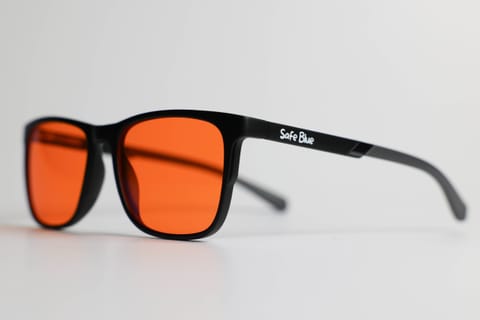
For orange lenses, the typical numbers are of another order of magnitude: 95–99% blocking up to around 530 nm, with a sharp cut (cutoff) beyond which transmission rises rapidly. To give a concrete, verifiable reference: SAFEBLUE Classic blocks 99% between 400 and 500 nm and 85% between 500 and 530 nm, with a cutoff at 530 nm and an overall visible light transmission of 65%. That 65% means the scene appears a little less bright, but stays comfortably above the comfort threshold for indoor work.
The key difference lies precisely in the coverage of 480 nm: the blue-green band that circadian-rhythm studies indicate as the most relevant for evening melatonin suppression. A clear lens, however good, can’t cover it without ceasing to be clear. An orange lens covers it by construction. If your main interest is the relationship between blue light and sleep, this is the figure to look at before any other.
A final note on data transparency: be wary of lenses sold without a transmission curve or without percentages tied to precise bands. “Blocks harmful blue light” with no numbers isn’t information, it’s a slogan. In our article on how to test blue light glasses we explain which checks you can do at home and which instead require lab instruments.
Comparison table: orange vs clear lens
| Characteristic | Clear lens with filter | Orange lens |
|---|---|---|
| Predominant technology | Reflective coating (+ possible light pigment) | Absorbing pigment in the body |
| Typical block 400–450 nm | 30–65% (peak at 410–420 nm) | 95–99% |
| Typical block at 450–460 nm (screen LED peak) | 10–30% | 98–99% |
| Typical block at 480 nm (melanopsin peak) | 5–15% | 95–99% |
| Typical block 500–530 nm | ~0% | 80–95% |
| Visible light transmission | 90–98% | 50–70% |
| Colour rendering | Neutral or nearly (slight straw tinge) | Evident warm cast, blues heavily dimmed |
| Suitable for colour work | Yes | No |
| Visible reflections on the lens | Yes, bluish | Minimal |
| Typical use | All day, professional contexts | Evening, intense evening sessions |
| Night driving | Generally yes (check the individual model) | No (transmission below the required threshold) |
| Typical price | €20–150 (up to €300+ if prescription) | €30–90 |
The values are typical market ranges: the individual model may deviate, and that is exactly why the transmission curve published by the maker is the first requirement to demand.
The price to pay: colour rendering
Here lies the real trade-off, and it’s only fair to say it plainly: an orange lens alters colours. Blues become dark and desaturated, whites shift to cream, your computer interface takes on an amber tone. In the first few minutes the effect is obvious; then the visual system performs a chromatic adaptation and the cast becomes much less perceptible, but it doesn’t disappear physically: if you have to judge a colour, you’re judging it through a filter. We’ve devoted a whole article to this topic — do orange lenses make you see everything orange? — because it’s the most honest question you can ask before buying.
The clear lens, by contrast, is designed to be chromatically invisible. The best ones introduce only a straw tinge perceptible on pure white backgrounds, and reflective coatings can create annoying bluish reflections in video calls (your interlocutor sees them on your lens). But a graphic designer, a photographer or anyone working with colour can keep them on all day without compromising their colour judgement.
In other words: filtering and colour fidelity are two pans of the same scale. The more weight you shift onto one, the more the other rises. Any product claiming 99% blue blocking and perfectly natural colours is describing something the physics won’t allow.
Who the clear lens makes sense for
The clear lens is the reasonable choice in these scenarios:
- You work with colour. Graphics, photography, video editing, print, fashion: any activity where colour judgement is part of the job rules out the orange lens during the activity itself.
- In-person professional contexts. Meetings, reception desks, sales: an orange lens gets noticed, a clear one doesn’t. It is a legitimate aesthetic consideration.
- Generic daytime use. By day, melatonin suppression isn’t the issue (on the contrary, intense daytime light serves the circadian rhythm, as the research gathered by f.lux reminds us). If you want a “companion” filter for office hours, the clear one is less intrusive.
- You already wear prescription glasses and want to integrate the filter into the prescription lenses: in this case the clear one with a coating is the standard option offered by opticians.
You must be aware, though, of what you’re buying: a partial filter, concentrated on violet, with minimal effect on the 480 nm band. If your motivation is sleep or the evening in front of screens, the clear lens is objectively the wrong tool.
Who the orange lens makes sense for
The orange lens is the consistent choice in these scenarios:
- Evening use in front of screens. TV series, gaming, working late: in the 2–3 hours before bed, the orange lens is the only type of glasses that substantially covers the 450–530 nm band across the whole field of vision, screens and home lighting included.
- Multiple screens and lights at once. Unlike software night modes, the physical filter covers everything you look at: monitor, TV, smartphone, LED lamps. The detailed comparison is in night mode vs glasses.
- A preference for measurable data. If you want to know exactly how much filter you’re applying, an orange lens with a published transmission curve gives you a verifiable number, not a promise.
- Subjective sensitivity to evening brightness. Many people report finding evening vision more comfortable with a warm cast and reduced luminance. It is a legitimate use preference, not to be confused with a demonstrated clinical benefit.
The limit is the mirror image: no colour work, no night driving, an “evening” look. It is not a pair to keep on 16 hours a day, and it’s right that no one should sell it to you as such.
What the science says
Due honesty on a point that the sector’s marketing tends to skip. The 2023 Cochrane systematic review (Singh et al., 17 randomised controlled trials) concluded that blue light filtering lenses may produce no difference compared with normal lenses on short-term visual fatigue, and that the evidence on sleep-related outcomes is conflicting and of limited quality. The American Academy of Ophthalmology, along the same lines, doesn’t recommend filtering glasses for screen discomfort, attributing the annoyances more to usage habits (few breaks, reduced blinking, wrong distances) than to the light itself.
Two useful clarifications for reading this data correctly. First: almost all the studies included in the review concerned clear lenses with modest filtering; high-filtering orange lenses have been studied above all in relation to evening melatonin, with interesting results but on small samples. Second: “the evidence is weak” doesn’t mean “demonstrated effect equal to zero”, it means better studies are needed. In the meantime, the honest position is the one we adopt too: an orange lens guarantees you a measurable physical fact (the blue light that doesn’t reach your eyes), not a clinical outcome. For a full analysis of the literature, read do blue light glasses work?.
Frequently asked questions
How much does a clear lens with a blue light filter really block?
It depends on the model, but the typical declared range is 30–65% below 450 nm, almost always measured at the most favourable point (410–420 nm). At the real screen emission peak (450–460 nm) the effective block often drops below 20–30%, and at 480 nm it’s almost nil. Always ask for the full transmission curve.
Can orange lenses be used during the day?
They can, but generally it isn’t worthwhile. By day, exposure to light, blue included, is physiological and useful to the circadian rhythm. The orange lens is at its best in the evening hours; by day a clear one (or no filter, with good breaks) is a more sensible choice.
Can I drive at night with orange lenses?
No. With visible transmission around 50–70% and strong dimming of blue, orange lenses don’t meet the requirements for night driving set by the EN ISO 12312-1 standard for eyewear. For night driving you need lenses with transmission of at least 75% and specific requirements on the recognition of light signals.
Why does my clear lens reflect blue?
It is the sign of an interference coating: it sends back part of the short wavelengths, and that reflected residue appears bluish or violet. It is normal; it is also the reason this technology can’t push beyond modest filtering without becoming a mirror.
Is a yellow lens a good middle ground?
In part. Yellow lenses typically block 60–90% below 450 nm with a more contained cast, but let through most of the 480–530 nm band. They are a reasonable compromise for anyone who can’t tolerate orange, knowing that the coverage of 480 nm stays partial.
Does the filter lose efficacy over time?
The in-body pigment is stable: it doesn’t wear out and doesn’t fade under normal use conditions. The reflective coatings of clear lenses, by contrast, can scratch or deteriorate, locally reducing efficacy. In both cases, cleaning with a microfibre cloth is sufficient.
How do I verify the declared percentages?
The reliable method is measurement with a spectrophotometer, which some opticians and labs can do. The “blue pen tests” sold with cheap glasses aren’t reliable: the pen emits violet light (~405 nm), which almost any lens blocks, and says nothing about 450–500 nm. More detail: how to test blue light glasses.
I work with colour but I’d like a serious filter: what do I do?
Use the two tools at different times: no filter (or a light clear one) during daytime colour work, an orange lens in the evening when colour judgement is no longer needed. It is the setup we most often suggest to graphic designers and photographers.
Is there a lens that blocks 99% of blue without altering colours?
No, and anyone promising it is selling a physical contradiction. Removing 99% of the 400–530 nm band means removing the blue component of the scene: no coating can do that while staying colourless.
In short
Clear lens and orange lens are not two levels of the same product: they are two different tools. The clear one favours looks and colour fidelity, filtering little and almost only in the violet; the orange one favours filtering (95–99% up to 530 nm, including the critical 480 nm band) while accepting a warm cast and predominantly evening use. The right choice depends on when you use screens and what you expect from the filter — and now you have the numbers to decide. If your scenario is the evening one, take a look at SAFEBLUE Classic: an orange lens with a declared transmission curve (99% blocking between 400 and 500 nm, 85% between 500 and 530 nm), €49.90 and a return within 30 days if it’s not for you. And if you want a wider picture before choosing, our guide on how to choose blue light glasses lines up all the criteria that count.
Sources
This article is for information only and does not constitute medical advice. See a qualified optometrist for any vision concerns. SAFEBLUE is a visual comfort accessory, not a medical device.
Related articles
Night Mode vs Glasses: What Actually Filters?
Night Shift, Night Light and f.lux shift the white balance; glasses filter the whole field of vision. Measurements, limits and how to combine them.
Blue light glasses: prescription or not? All the options
You wear prescription glasses and want a blue light filter? Contacts plus plano lenses, clip-ons or filtered prescription lenses: costs and trade-offs compared.
Do orange lenses make everything look orange?
Yes, there's a warm cast. But your visual system adapts: when you stop noticing it, when it stays a problem and when it doesn't. The honest answer.
How to Choose Blue Light Glasses: Criteria and Data to Ask For
Blocking percentages per nm range, CR-39 or polycarbonate, visible transmission, CE and UV400: the concrete criteria for choosing blue light glasses.