Do blue light glasses work? What the research says
Do blue light filtering glasses work? The honest answer: what the research says, what is debated and when they make sense. No inflated promises.
· 15 min read
If you have typed “do blue light glasses work” into a search box, you have probably already run into two opposite versions of the same story. On one side, pages that describe them as the answer to every screen-related complaint; on the other, articles that dismiss them as marketing. The truth, as so often happens, sits somewhere in between, and it is more interesting than either caricature.
The short, honest answer is this: blue light filtering glasses do one thing that is measurable and verifiable — they block a portion of the light spectrum emitted by screens. What is debated is whether that filtering translates into real benefits for comfort or for sleep. The 2023 Cochrane review, the most cited independent synthesis on the subject, found no strong evidence to support those effects. At the same time, many people who spend hours in front of a monitor find them pleasant to wear in the evening.
In this article I will explain what the research actually says, where the data ends and expectation begins, and how to work out whether they make sense for you. No superlatives, no promises: just what we can say honestly.
The question behind the question: what do we mean by “work”
“Work” is a slippery word, because it can mean very different things. Before looking at the studies, it helps to separate three claims that are often blurred into a single sentence.
The first is purely physical: does the lens filter part of the blue light? This is easy to verify in a laboratory with a spectrophotometer, and it is a matter of fact. A filtering lens lowers the intensity of the blue light reaching the eye in the wavelengths it blocks. There is no debate here: either the lens cuts those frequencies or it does not, and the spec sheet tells you which.
The second claim is about visual comfort: does wearing them make the experience in front of a screen more pleasant, especially in the evening? Here we enter subjective territory that is harder to measure, because comfort depends on dozens of factors — room lighting, distance from the monitor, how often you blink, your own vision correction.
The third is the most ambitious: do the glasses produce a documented clinical benefit, for example on sleep or on fatigue measured with instruments? This is where the research is most cautious and where marketing promises tend to overreach.
When someone asks “do they work?” they usually mix all three. The physical part is certain; the other two are the real object of the scientific debate. If you want to understand where blue light comes from in the first place, we have dedicated a whole article to what blue light is.
What the research actually says
It is worth looking at the sources without filtering them through hearsay. Three references help frame the picture: the Cochrane review, the positions of the ophthalmology academies and the individual experimental studies on sleep.
The 2023 Cochrane review
In 2023 a group of researchers led by Singh published a systematic review in the Cochrane Database of Systematic Reviews titled “Blue-light filtering spectacle lenses for visual performance, sleep, and macular health in adults”. Cochrane is considered one of the most rigorous standards for synthesising evidence: it does not run new experiments, but gathers and weighs all the available controlled studies on a question.
The conclusion, in short, is cautious. The authors found no strong evidence that blue light filtering lenses improve visual performance in front of a screen, nor that they have a meaningful short-term effect on comfort compared with ordinary lenses. They also noted that the included studies were often small, short and of variable quality, which makes it hard to draw firm conclusions in any direction.
It is important to read this result for what it is. “No strong evidence of a benefit” is not the same as “firm proof that they do nothing”: it means that, with the current data, science cannot say with confidence that they produce the promised effect. It is a position of caution, not a condemnation. For many consumer products, this is simply the state of knowledge.
What the ophthalmology academies say
The American Academy of Ophthalmology has held a consistent position for years: according to the AAO there is no need to spend on special glasses for computer use, because the blue light from screens has not been shown to cause harm to the eyes. The academy attributes the typical complaints from prolonged use — dryness, tired vision, slight blurring — mostly to the way we use screens: we blink less, we stay focused at close range for hours, often under less than ideal lighting.
It is a distinction that changes the perspective. If the main source of the discomfort is behaviour (few breaks, low blink rate, posture), then the most effective lever is not necessarily a filter, but habits. We talk about this in digital eye strain symptoms, where you will also find the 20-20-20 rule and its limits.
The studies on evening sleep
On the sleep front the picture is slightly different, and here it pays to be precise. There are experimental studies showing that evening blue light can lower melatonin production and shift the body clock — for example Cajochen’s work on LED screens or Chang’s on backlit e-readers. These studies, however, measure the effect of the light itself, not of the glasses.
On the specific question of glasses, some small experiments — such as the 2018 randomised trial by Shechter on people with insomnia, who wore amber lenses two hours before sleep — have suggested possible effects on self-reported sleep. But these are small samples, preliminary findings and not always replicated. It is exactly the kind of evidence that Cochrane considers “weak”. We go deeper into all of this in blue light and sleep, where we separate what concerns light from what concerns glasses.
Why so many people find them useful anyway
At this point you might ask: if the research is so cautious, why do so many people — programmers, traders, designers, people who watch shows late at night — keep wearing them and saying they feel better?
There are plausible explanations that do not require believing miracle claims. The first is perceived comfort: an orange lens lowers the overall intensity of the blue component and slightly softens the aggressive contrast of certain screens, and for some people this makes the image feel gentler and less “cold”, especially in the evening in a dark room. It is a legitimate aesthetic and sensory preference, not a clinical effect.
The second is ritual: putting on glasses at a certain hour can act as a signal of the shift into the evening part of the day. It is not the glasses themselves that make the difference, but the habit that goes with them.
The third, more uncomfortable, is the placebo and expectation effect, which is famously strong in research on visual comfort. It is not a flaw in the person: it is the reason controlled studies need a comparison group. The honest point is that subjective relief is real even when we cannot attribute it with certainty to the filter.
Acknowledging all of this does not mean advising against the glasses. It means selling them — or rather, describing them — for what they are: a visual comfort accessory that many people like, not a remedy. If the lens colour intrigues you, we have compared orange lenses and clear lenses, explaining why the cut is different.
What they do NOT do (and what no glasses can do)
To be truly useful we also have to say clearly what these glasses do not do, because this is where the most aggressive marketing loses the plot.
They are not a medical device and should not be used as one. They are not a substitute for a check-up: if you have frequent headaches, persistent blurred vision, red eyes or pain, the right thing is to talk to an eye doctor, not to buy a pair of glasses online. A persistent complaint can have causes that a filter does not touch in the slightest.
They do not correct vision defects if you have no prescription. A blue filter is one thing, a corrective lens is another; there are versions with and without prescription, and we have explained the difference in blue light glasses with or without prescription.
And they do not work magic on sleep. Even taking the most optimistic studies at face value, the effect of evening light depends on intensity, duration, timing and individual sensitivity: a pair of glasses worn for ten minutes before bed while you scroll your phone at full brightness does not turn the situation around. Often a simpler lever is night mode versus glasses, or simply lowering your screen brightness.
How to read a label without being fooled
If you decide you want to try them, the best way not to waste money is to read the spec sheet instead of the slogan. Three numbers really matter.
The first is how much blue light it blocks and in which range. A sentence like “blocks 99% of blue light in the 400–500 nm range and 85% between 500 and 530 nm” is verifiable and tells you exactly what the lens does. Vague phrases like “advanced anti-blue filter” with no numbers mean nothing.
The second is the cutoff point: the wavelength above which the lens lets light pass almost entirely. A higher cutoff (for example 530 nm) means more aggressive filtering and, usually, a more visibly orange tint; a lower cutoff filters less but stays almost clear. There is no “right” value in absolute terms, there is the one suited to your use.
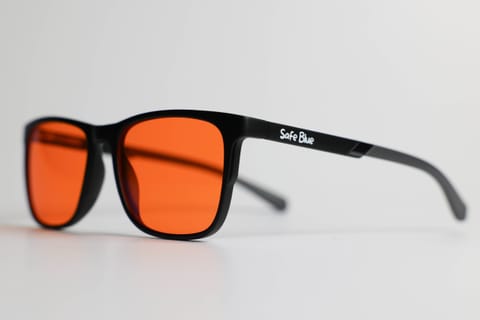
The third is the visible light transmission: how much total light gets through. A value around 65% indicates a clearly filtering lens, designed for the evening; higher values correspond to lighter lenses for daytime use. As a concrete example, SAFEBLUE Classic uses an orange lens that blocks 99% of blue light between 400 and 500 nm, 85% between 500 and 530 nm, with a cutoff at 530 nm and visible transmission around 65%: numbers designed for people who are at screens in the evening, stated for exactly what they are.
Be wary, instead, of three things: promises of benefits for sleep or fatigue presented as certain; a total absence of spectral numbers; and inflated prices justified by claims that the research does not support. If you want a step-by-step method, we have written how to choose blue light glasses.
Who they may suit and who they will not
The question “do they work?” becomes more useful if you turn it into “do they work for me, for what I need?”. There are profiles for whom an orange lens has a good chance of feeling pleasant, and others for whom it is simply superfluous. Telling them apart saves you both disappointment and money.
People who spend many hours at screens in the evening and want a softer, less “cold” visual sensation in front of the monitor tend to get on well with them. Those who are sensitive to very bright displays, who work late, or who simply enjoy the ritual of “switching into evening mode” often describe the glasses as pleasant to wear. Even those who have tried the night settings on their devices and want a filter that works on any source — not just on a single screen — may find them handy. In all these cases the value is perceived comfort, and that is a legitimate reason.
They make little sense, on the other hand, for someone expecting them to solve a problem. If you are looking for something to make frequent headaches disappear, to send you to sleep on command, or to shield your eyes from supposed harm, you are asking the wrong object: none of these things is demonstrated, and a persistent complaint should be assessed by an eye doctor. They are also unsuitable for anyone who needs to judge colours precisely — photographers, designers, anyone doing retouching work — because an orange tint by definition alters colour rendering as long as you wear it. And they are excessive for someone who spends little time at screens or mostly does so during the day, where the topic is less relevant.
In between sits the majority of people, for whom the honest answer is: try them if they intrigue you, choosing a product with clear numbers and a good returns policy, and judge for yourself whether you like the feeling. It is a decision about comfort and taste, not a bet on health.
Why we care about being honest about claims
You might wonder why a brand that sells glasses insists so much on the limits of the research. The answer has two sides, and both work in your favour.
The first is regulatory. In Europe, health claims on consumer products are strictly governed: you cannot attribute to an accessory a clinical benefit that has not been demonstrated. SAFEBLUE is a visual comfort accessory, not a medical device, and describing it for what it is is not a limitation but the correct way to talk about it. When a site promises you that glasses “will make you sleep” or “will get rid of fatigue”, it is making a claim the research does not support and one that supervisory authorities view with suspicion.
The second is trust. We would rather tell you what the lens does — block a measurable portion of blue light — and let you decide, than inflate expectations we then cannot meet. A customer who buys understanding what they are buying is more satisfied than one persuaded by a promise. It is also why we put the Cochrane review front and centre instead of hiding it: honesty about the limits is our strategy, not an accident.
Frequently asked questions
Do blue light glasses work for headaches?
We cannot claim so, and no honest page should. The Cochrane review found no strong evidence of clinical benefits of this kind, and headaches have many possible causes. If yours are frequent, the sensible thing is to talk to a doctor or eye doctor rather than rely on a filter.
Are they useful if I use the computer all day for work?
You may like them for perceived comfort, but the ophthalmology academies attribute screen-related complaints mostly to few breaks, low blink rate and lighting. Habits matter more than the filter: regular breaks, correct distance and good lighting often make more difference than any lens.
Why does Cochrane say there is no strong evidence if many people recommend them?
Because “recommended from experience” and “demonstrated by controlled studies” are different things. Cochrane weighs only good-quality experimental evidence, which today is scarce and weak. This does not mean you cannot like them, but that science cannot yet confirm the promised benefits.
Does the orange lens filter more than the clear one?
Generally yes: a lens with an orange tint and a higher cutoff blocks a larger portion of the blue spectrum than an almost clear lens. In exchange, it alters colour perception more. It is a trade-off between amount of filtering and colour rendering.
Can they make colour vision worse?
An orange lens shifts colour perception towards warmer tones as long as you wear it: it is an expected effect, not a flaw. That is why it is not ideal if you need to judge colours precisely, as in photo editing. We talk about this in orange lenses and colour perception.
Is it worth buying them or are screen settings enough?
It depends. The night modes on phones and computers already lower the blue component for free. Glasses add a physical filter and work across different devices. For many people the most rational choice is to start with the settings and consider glasses only if you want something extra.
Do they work for children?
The question of children is delicate and should be approached with a professional. Agencies such as ANSES note that younger people are more sensitive to light, but this concerns exposure in general, not the effectiveness of the glasses. We have gathered the cautions in blue light glasses for children.
Is there a risk in wearing them even if they did nothing?
For normal use in front of screens, no notable risks are reported. Wearing orange lenses while driving at night, or in situations where faithful colour rendering matters, is not a good idea, because they alter perception. Otherwise, the main “risk” is financial: paying too much for expectations they cannot meet.
In short
Blue light filtering glasses do one certain thing — they block a measurable part of the blue spectrum from screens — and a series of debated things, above all the benefits for comfort and sleep, which the 2023 Cochrane review does not consider demonstrated. Our position is simple: if you like them for evening visual comfort and choose a product with stated numbers at an honest price, they can be a pleasant accessory. If you are looking for a remedy for persistent complaints, the right answer is an eye doctor, not a pair of glasses.
If you want to carry on, start with what blue light is to understand the physics, or look at the best blue light glasses already knowing which questions to ask. The most useful thing we can give you is not a promise: it is the full picture, so you decide.
Sources
- Cochrane Review — Singh et al. (2023), Blue-light filtering spectacle lenses for visual performance, sleep, and macular health in adults
- American Academy of Ophthalmology — Digital Devices and Your Eyes
- Harvard Health Publishing — Blue light has a dark side
- Shechter et al. (2018) — Blocking nocturnal blue light for insomnia: a randomized controlled trial
- ANSES — LEDs & blue light
This article is for information only and does not constitute medical advice. See a qualified optometrist for any vision concerns. SAFEBLUE is a visual comfort accessory, not a medical device.
Related articles
What is blue light? Spectrum, wavelengths and sources
What is blue light, explained simply: the visible spectrum, wavelengths, why 400–530 nm, natural and artificial sources. A clear and honest guide.
Effects of blue light on the eyes: what is documented
Effects of blue light on the eyes: what the research says and what it does not, acute and chronic exposure, screen complaints. A careful guide, no alarmism.
Blue light and sleep: melatonin, circadian rhythm, data
Blue light and sleep: what studies say about melatonin and the circadian rhythm, the effect of evening light and why glasses are not a promise of sleep.
Orange vs Clear Lens: The Real Differences
Transmission spectra, blocking percentages and colour rendering: the technical comparison between orange and clear lenses, to work out which suits you.