Blue light glasses: prescription or not? All the options
You wear prescription glasses and want a blue light filter? Contacts plus plano lenses, clip-ons or filtered prescription lenses: costs and trade-offs compared.
· 14 min read
Almost all blue light filtering glasses are made as plano lenses — that is, with no vision correction. That’s a real problem for a huge slice of potential wearers: a majority of adults in Ireland and across Europe wear glasses or contact lenses, and someone who spends eight hours a day in front of a monitor with short sight to correct can’t simply take their glasses off and put on a different pair.
The good news is that there are at least four workable routes, each with different costs and compromises: wearing contact lenses and putting plano filtering glasses over the top; clipping a filter onto your prescription frame; having your optician make prescription lenses with the filter built in; or using “fit-over” filtering glasses designed to sit over your existing frame. There is no universally right answer — only the right one for your particular combination of prescription, budget, screen hours and tolerance for the look.
In this guide we compare the four options one by one, with real prices from the Irish and wider EU market and the weak points sellers tend not to mention — including the important fact that the filters built into clear prescription lenses block far less than a dedicated orange lens. At the end you’ll find a summary table and our suggestions for the most common cases.
The four routes for glasses wearers
Before the detail, a quick map. The options fall into two families.
Family A — the filter is a second object: contact lenses plus plano glasses (option 1), a clip-on over your glasses (option 2), a fit-over over your glasses (option 4). Here you keep your current correction and add the filter only when you want it. The shared advantage: you can pick a real filter, even a high-filtration orange lens, and wear it only in the evening. The shared drawback: two objects to manage.
Family B — the filter goes into the prescription lenses (option 3): the optician makes prescription lenses with a blue light filter built in, almost always clear. Advantage: a single pair of glasses, nothing to think about. Drawback: the filtration is modest and fixed — you wear it even when you don’t need it, and you can’t turn it up when you would.
This distinction is the heart of the choice, because it ties directly to what we documented in our comparison of orange vs clear lenses: clear filtering lenses typically block 30–65% below 450 nm (often measured at the most favourable point), whereas dedicated orange lenses reach 95–99% up to 530 nm. If your goal is serious filtration in the evening hours, Family A is all but compulsory.
Option 1: contact lenses plus plano filtering glasses
If you wear (or can wear) contact lenses, this is the cleanest solution: the contacts do the vision correction, the filter is handled by an ordinary plano pair, identical to what someone with no prescription would buy.
The upside. Maximum freedom of choice on the filter: you can buy a documented high-filtration orange lens with no prescription constraints, and swap or upgrade it without remaking expensive lenses. You pay list price for the glasses (€30–90 for a serious product), without the mark-up that comes with prescription lenses. And the plano pair doesn’t depend on your prescription: if your script changes, the filter is still valid.
The trade-offs. You have to get on with contact lenses, and here’s a detail anyone who works a lot at a computer knows well: in front of a screen we blink less, the eyes tend to dry out, and contacts can make that dryness more noticeable over long sessions. The American Academy of Ophthalmology, discussing screen discomfort, recommends exactly this — regular breaks (the 20-20-20 rule) and artificial tears when needed. If your contacts already bother you by the end of the day, building your evening strategy on top of them is not a good idea. There’s also the recurring cost of the contacts themselves (€15–50 a month for dailies), which of course you’re already paying if you wear them anyway.
Who it suits. Anyone who wears contacts comfortably all day and wants the strongest possible filter in the evening, at the lowest overall cost.
Option 2: a clip-on filter over your glasses
Clip-ons are filtering lenses without a full frame that attach to your prescription frame with a small clip or magnets. They come in clear, yellow and orange, at €15–50.
The upside. Low cost, no change to your glasses, on and off in a second: the filter is there only when you want it. For anyone wanting to try the effect of an orange lens before investing in something pricier, it’s the cheapest ticket in.
The trade-offs. This is the most fragile option, both practically and cosmetically. The extra weight on the bridge is noticeable; a poor clip can scratch your prescription lenses; and the air gap between the prescription lens and the filter lens creates double reflections, annoying above all in the evening with point light sources. The optical quality and spectral documentation of cheap clip-ons is often thin: few makers publish transmission curves. And the look, let’s be honest, is what it is.
Who it suits. Anyone who wants to spend little to find out whether the evening-filter route is for them, or anyone who switches between filter and no-filter through the day. As a permanent solution it convinces less: if the experiment works, people usually move to option 1, 3 or 4.
Option 3: prescription lenses with a built-in filter from your optician
This is the “official” route: when you order new lenses, ask your optician to include the blue light filter. Technically there are two variants — the filter as a reflective coating on the surface, or an absorbing filter built into the body of the lens — and we cover them in detail in our guide to prescription blue light glasses.
The upside. A single object to manage: your everyday glasses, with a filter working quietly in the background all day. Lab-grade optical quality, professional centring, compatibility with varifocals and complex prescriptions. For many people it is simply the only realistic option, because contact lenses aren’t workable and two pairs of glasses on top of each other can’t be tolerated.
The trade-offs. The first is filtration: prescription lenses with a filter are almost always clear, with typical blocking of 10–30% at the real emission peak of screens (450–460 nm) and almost nothing at 480 nm. No optician will make you orange varifocals for everyday use — nor would it make sense, given the permanent colour cast. The second is cost: the filter typically adds €30–100 to the price of the lenses, which for a quality varifocal means landing at €300–700 a pair. The third is rigidity: the filter is always there, even when you’re working on colour or when you don’t need it, and to turn it up in the evening you have to add something else anyway. It’s also worth recalling the science: the 2023 Cochrane review, conducted largely on clear filtering lenses just like these, found no clear difference in short-term visual fatigue compared with ordinary lenses.
Who it suits. Anyone wanting a single, no-fuss solution and accepting modest filtration; anyone with complex prescriptions; anyone who can tolerate neither contacts nor a second pair on top.
Option 4: fit-over filtering glasses (over your glasses)
Fit-overs are filtering glasses with a wide shell, designed to be worn over your prescription frame. They come from the world of sunglasses and post-operative eyewear and exist in orange versions with high filtration.
The upside. Genuine orange-lens filtration (95–99%), side coverage too (light entering from the side is a weak point of every other option), modest cost (€20–60), no change to your glasses and no contact lenses.
The trade-offs. Bulk and looks: these are visibly large objects, made for the living room, not the video call or the train. The combined weight of two frames tells over long sessions, and compatibility depends on the size of your frame: before buying, check the internal dimensions of the shell.
Who it suits. Anyone who wears glasses, wants maximum filtration in the 2–3 evening hours at home, and has no cosmetic concerns in that setting. On the sofa, in front of the TV, it’s the best value for anyone who can’t use contacts.
Costs compared
| Option | Up-front cost | Recurring cost | Achievable filtration | Main compromise |
|---|---|---|---|---|
| Contacts + plano filter glasses | €30–90 (glasses) | Contacts (€15–50/month, if not already worn) | High (95–99% with orange lens) | Contact-lens comfort over long sessions |
| Clip-on filter | €15–50 | None | Medium–high (depends on model, documentation often thin) | Double reflections, fragility, looks |
| Prescription lenses with filter | +€30–100 on lens cost (total €150–700) | Repaid at every prescription change | Low (clear: 10–30% at 450–460 nm) | Modest, non-adjustable filtration |
| Orange fit-over | €20–60 | None | High (95–99%) | Bulk and looks |
For the full picture of market prices, prescription and otherwise, we have a dedicated guide: how much blue light glasses cost.
Which to choose for your case
Let’s turn the comparison into concrete recommendations, by profile.
You wear contacts with no trouble. Option 1, no hesitation: a plano orange pair in the evening, and possibly no filter at all during the day. It’s the most effective and cheapest combination over the long run.
You wear glasses only, work a lot at the PC, ample budget. New prescription lenses with a clear filter for the day (knowing the filtration is a side effect, not the main event) plus an orange fit-over or clip-on for the evening. It covers both scenarios, at the price of managing two objects.
You wear glasses only, limited budget. Start with an orange clip-on (€15–40) to test the evening habit. If after a month you genuinely use it every evening, consider moving to a quality fit-over or, at your next prescription change, the built-in filter.
You have a light prescription and use glasses for screens only. A particular but common case: ask your optician for an honest assessment. For some tasks and minimal prescriptions, swapping between your glasses and a plano filtering pair in the evening hours can be acceptable; it’s a decision to make with a professional who knows your script, not on your own.
You work with colour (graphics, photo, video). Whichever option you choose, the serious filter belongs outside colour-work hours. Clear prescription lenses with a light filter for the day, a separate orange filter for the evening. Why is explained in do orange lenses tint everything?.
In every case, the method advice from our guide on how to choose blue light glasses holds: demand the spectral data, whatever the filter’s format. A clip-on with no transmission curve and a prescription lens “with blue filter” but no per-band percentages are purchases made blind.
A common mistake: confusing correction with filtration
It’s worth clearing up a misunderstanding that leads to bad choices. Many people talk about “computer glasses” as if they were a single category, mixing up two distinct things: vision correction (which resolves short sight, long sight, astigmatism, presbyopia) and the blue light filter (which cuts one band of the light spectrum). They are independent functions: you can have one without the other in any combination.
That means the question “prescription or not” and the question “how much filter do I want” should be decided separately. Anyone with a refractive error must first sort out the correction (contacts, glasses, prescription lenses) and then, independently, choose whether and how much to filter blue light. Mixing the two leads to the most frequent errors: buying prescription lenses with a light filter believing you’ve also sorted the evening front, or buying a strong plano filter while forgetting that without correction you can’t see the screen well.
The practical rule is simple: treat correction as a non-negotiable requirement (your optician gives it to you based on your script) and the filter as a separate choice, calibrated to when and how much you use screens. The four options in this guide are exactly the different ways of combining these two layers.
What the research says, briefly
To close the loop honestly: whichever option you choose, it’s worth knowing that the scientific evidence on the benefits of blue light filters is limited. The 2023 Cochrane review found no clear difference in short-term visual fatigue between filtering lenses and ordinary ones, and the American Academy of Ophthalmology attributes much screen discomfort to usage habits (too few breaks, reduced blinking, wrong distances) rather than to the light itself. This doesn’t make the filter useless — blocking blue light remains a measurable physical fact, and many people report more evening comfort — but it places the spend in the right frame: you’re buying a physical figure and a usage preference, not a guaranteed clinical outcome. Worth keeping in mind above all when faced with the mark-up for the built-in filter in prescription lenses, the dearest of the four options.
Frequently asked questions
Can I put plano filtering glasses over my prescription glasses?
Two standard frames stacked work badly: geometries not designed to coexist, double weight on the nose, reflections in the gap. If you want the stacking approach, choose a fit-over designed for it, with a shell sized to contain your prescription frame.
Do orange prescription glasses exist?
To order, some labs make body-tinted prescription lenses, orange included. The costs are high (often €200–400 for the lenses alone), the lead times long and the colour cast permanent: for most people, a fit-over or the contacts-plus-plano combination is more sensible.
How much does the filter in clear prescription lenses really block?
Quoted figures reach 30–65% below 450 nm, but they’re almost always measured at 410–420 nm. At the real screen peak (450–460 nm) typical blocking drops to 10–30%, and at 480 nm — the band most relevant to the circadian rhythm — it’s almost nil. It’s a side filter, not comparable to an orange lens.
Are blue light filtering contact lenses an alternative?
Some makers offer contacts with partial absorption in the violet-blue. The filtration percentages are low, comparable to or below clear filtering prescription lenses: they don’t replace a serious evening filter.
Does the clip-on damage my glasses lenses?
It can happen with cheap rigid-spring clips: micro-scratches on the lens coating at the contact point. Models with rubberised contact points or magnetic attachment (on frames set up for it) are much safer on this front.
With varifocals, does the built-in filter work differently?
No, the filter acts on the whole surface regardless of the varifocal geometry. What changes is the price: on mid-to-high-end varifocals the filter adds a smaller percentage, but the total easily climbs above €400–500.
How much does the filter add to the cost of prescription lenses?
In the Irish and EU market, typically €30–100 more per pair than the same lenses without a filter, depending on the maker and type (coating or body tint). Always ask for a quote on both variants to see the real impact.
Can people with no refractive error use “relaxing” prescription lenses with a filter?
There are lenses with small accommodative supports designed for near work, with or without a filter. It’s a strictly individual assessment to make with an optometrist or an ophthalmologist after a sight test: not a purchase to make online sight unseen.
In short
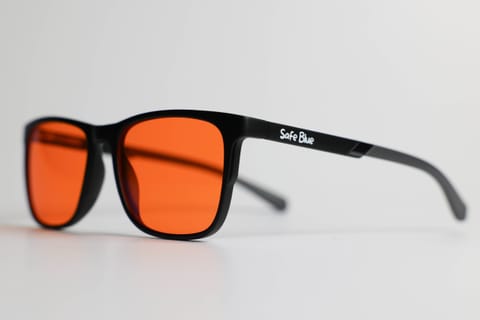
If you wear glasses, a blue light filter isn’t off limits: you have four routes, and the choice depends on what you’re after. Real filtration (95–99%, orange lens) is only achieved with a filter separate from the correction: contacts plus a plano pair if you tolerate them, a fit-over or clip-on if not. The built-in filter in prescription lenses is handy and invisible, but it’s a light filter: choose it knowing that, not hoping it does the job of an orange lens. For the plano-over-contacts route, SAFEBLUE Classic is our reference point: an orange lens with a stated 99% block between 400 and 500 nm, €49.90 and 30-day returns — long enough to work out, on your own sofa and with your own screens, whether it’s the right answer for your evenings.
Sources
This article is for information only and does not constitute medical advice. See a qualified optometrist for any vision concerns. SAFEBLUE is a visual comfort accessory, not a medical device.
Related articles
Prescription blue light glasses: the honest guide
Got a prescription and want a blue light filter? Filters built into prescription lenses, the questions to ask your optician, and why SAFEBLUE is plano only.
Orange vs Clear Lens: The Real Differences
Transmission spectra, blocking percentages and colour rendering: the technical comparison between orange and clear lenses, to work out which suits you.
Night Mode vs Glasses: What Actually Filters?
Night Shift, Night Light and f.lux shift the white balance; glasses filter the whole field of vision. Measurements, limits and how to combine them.
How to Choose Blue Light Glasses: Criteria and Data to Ask For
Blocking percentages per nm range, CR-39 or polycarbonate, visible transmission, CE and UV400: the concrete criteria for choosing blue light glasses.