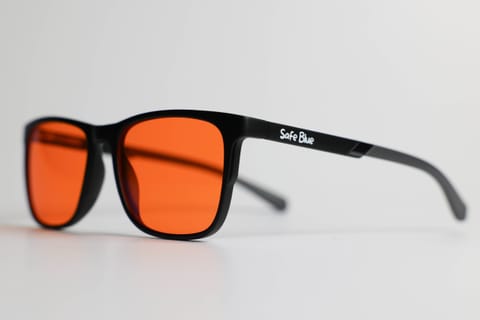
How Much Do Blue Light Glasses Cost? Budget and Real Cost
Beyond the list price: cost per hour of use, comparison with other desk spending, and a realistic budget for anyone at a screen 8 hours a day.
· 12 min read
“How much do blue light glasses cost?” admits two answers. The list-price one — from €10 to over €150, with the serious mid-range between €30 and €60 — you’ll find detailed in our analysis of the price tiers. This page answers the more interesting question: how much they really cost, that is, relative to how you’ll use them, how long they last and the rest of the budget that screen workers spend (or should spend) on their setup.
Changing the unit of measurement changes everything. A €50 pair looks like a middling expense until you compare it with a meal out; it becomes a tiny expense once you discover that, for typical work use, it works out at under 2 cents per hour of use — less than any other object on your desk, coffee included. Conversely, a €12 pair that ends up in a drawer after two weeks because it distorts or filters nothing has a cost per hour of use tending to infinity.
Transparency note, as always: SAFEBLUE sells glasses at €49.90, so when we talk about “a sensible mid-range” we are talking about ourselves too. The calculations that follow, though, are reproducible with any price and any product: change the numbers and run them again with the model you’re weighing up.
The list price in 60 seconds
For anyone who lands here without going through the dedicated article, the 2026 market in three lines:
| Tier | Price | In short |
|---|---|---|
| Budget (marketplace, pharmacy) | €8–25 | No documented filtering data, variable optical quality |
| Specialist mid-range | €30–60 | Filtering declared per nm band, optical materials, returns and warranty |
| Premium | €70–150+ | Premium frames, prescription lenses, brand, import |
The rest of this page assumes you want a product with verifiable data — so from the mid-range up, or a budget product chosen consciously as an experiment. On how to tell the serious products apart, the buyer’s guide lists the criteria one by one.
Cost per hour of use: the calculation that changes perspective
Glasses are an intensively used object: if you work at a computer, you wear them for longer than you use any other accessory you own. The correct way to assess their price is therefore to amortise it over the hours of actual use.
Let’s take three realistic profiles and three typical products. The assumptions: the glasses last at least as long as the warranty (2 years for serious brands; for budget we optimistically assume 1 year), and use is constant.
| Scenario | Hours/year | Product | Price | Lifespan | Cost per hour |
|---|---|---|---|---|---|
| Remote worker, 6 h/day × 250 days | 1,500 | Mid-range (e.g. €49.90) | €49.90 | 2 years | ~1.7 cents/h |
| Evening use only, 2 h/day × 350 days | 700 | Mid-range (€49.90) | €49.90 | 2 years | ~3.6 cents/h |
| Remote worker, 6 h/day × 250 days | 1,500 | Premium (~€120) | €120 | 2 years | ~4 cents/h |
| Occasional use, 1 h/day × 200 days | 200 | Budget (€15) | €15 | 1 year | ~7.5 cents/h |
Three observations the calculation makes plain:
- The more you use the glasses, the less they cost. For full work use, the difference between a €50 product and a €120 one is about 2 cents an hour: at that point the choice should be made on the filtering numbers and on comfort, not on price.
- Budget is cheap only if you actually use it. A frequent paradox: the €15 pair bought “to try” and abandoned after ten uses is, per hour of use, the most expensive you’ve ever owned.
- Lifespan is part of the price. A surface-coating filter that scratches within a year effectively halves the value of the purchase; a pigment in the body of the lens does not. It is one reason why two identical prices can hide different real costs.
Comparison with other desk spending
Screen workers already spend — or should — on a range of items for the comfort of their setup. Putting filtering glasses in that column, rather than the “gadget” column, helps to size the budget. Indicative market figures, annualised over the typical useful life of each item:
| Item | Typical spend | Useful life | Cost/year |
|---|---|---|---|
| Serious ergonomic chair | €250–600 | 7 years | €35–85 |
| Quality external monitor | €200–400 | 5 years | €40–80 |
| Adjustable desk | €300–600 | 8 years | €38–75 |
| Ergonomic keyboard + mouse | €80–180 | 4 years | €20–45 |
| Coffee out on working days | ~€1.30 × 220 days | — | ~€285 |
| Mid-range filtering glasses | €30–60 | 2 years | €15–30 |
The glasses line is the lowest for annual cost of all those listed — less than a tenth of the coffee. This does not automatically make them useful (a cheap but useless object stays useless: the discussion on effectiveness must be tackled separately and honestly), but it shrinks the weight of the decision: within the overall budget of a workstation, filtering glasses are a marginal line that lives or dies on relevance to your use case, not on affordability.
The reverse reasoning holds too: if your workstation budget is limited, glasses are not the first line item. A decent chair and a well-positioned monitor affect the overall comfort of a working day more — as plain ergonomic sense, echoed by the American Academy of Ophthalmology, suggests: for screen discomfort it recommends, first of all, regular breaks and a correct setup. Filtering glasses come afterwards, once the rest is in place and a specific objective remains: typically, shading the blue band in the evening hours, where — as Harvard Health documents — screen light interferes most with melatonin.
The total budget: three realistic profiles
The student (budget: €0–50)
Many screen hours, little money. Sensible priorities: free digital hygiene (night mode, breaks, room lighting), then perhaps a single filtering pair. If the objective is evening study, a documented mid-range orange pair (€30–50) makes more sense than two undocumented cheap products. The €15 budget pair stays an experiment option, knowing what to expect.
The remote worker (budget: €50–120)
Six to eight screen hours a day, often late into the evening. The sensible budget covers a main mid-range pair with per-band data (€30–60) and perhaps a second pair with a different tint for different contexts: clear or light amber for video calls, orange for the evening. Total: €60–120 every two years, i.e. €30–60 a year. We go deeper into the specific choices for this profile in glasses for remote work.
The screen professional (budget: €100–250)
Developers, traders, competitive gamers: 8–12 hours a day, specific needs (headphone compatibility, night sessions, possibly prescription lenses). Here premium can make sense: integrated prescriptions, more robust frames, two or three specialised pairs by time of day. The master rule still holds: every euro spent must correspond to documented filtering numbers, not to promises. A comparison of the serious brands on the market is in our overview of the best blue light glasses.
When it makes sense to spend more (and when it doesn’t)
Spending more makes sense when:
- you need prescription lenses with a filter: the prescription inevitably moves the price above €100;
- the glasses must live out of the house: better frames and hinges pay off in durability;
- you want a second specialised pair (e.g. evening orange in addition to daytime clear): it is the most effective way to cover different use cases, more than a single expensive “do-it-all” pair;
- the premium maker documents better numbers on your specific objective (e.g. a wider cutoff, higher VLT at equal blocking).
Spending more does NOT make sense when:
- the premium pays only for looks and brand while the spectral data are identical (or absent);
- you haven’t yet verified that the product category serves your case: before going up in price, read the honest discussion on effectiveness — the 2023 Cochrane review invites caution above all on clear lenses;
- you’re buying the third pair identical to the first two instead of diversifying tint or use context;
- the free alternative (breaks, lighting, night mode) hasn’t yet been seriously tried.
For our part: SAFEBLUE Classic costs €49.90 — deliberately mid-range — with 99% blocking across 400–500 nm, 65% VLT, a 30-day return and a 2-year warranty. We are biased, so translated into the language of this page: ~1.7 cents per hour of use for a remote worker, with the filtering numbers of the premium tier. If the comparison takes you elsewhere, that’s fine: the important thing is that data drives it.
The hidden costs to factor in
The purchase price isn’t the only number in the budget. Four items it’s best to know up front:
- Replacement through wear. Lenses with a surface-coating filter can lose efficacy with scratches and aggressive cleaning; those with pigment in the body age better. A microfibre cloth and a hard case (often included, otherwise €5–10) extend the life of any pair.
- Shipping and customs. Non-EU brands often add €10–25 between international shipping and any customs charges, on top of long and costly returns. It belongs in the comparison price.
- The missed return. If the fit is wrong and the return isn’t free or doesn’t exist, the glasses end up in a drawer: cost per hour of use infinite. The 30-day return belongs in the value, not as a detail.
- The lost pair. A petty but real statistic: objects that move between home, bag and office get lost. If the pair is €120, it hurts; if it’s €50, less so. This too is desk-side risk management.
Frequently asked questions
How much does a good pair of blue light glasses cost in 2026?
For a non-prescription pair with filtering documented per nm band, serious optical materials, returns and warranty: between €30 and €60. Below €25 the filtering data is almost always missing; above €70 you pay for premium frames, a prescription or brand. Amortised over two years of work use, a mid-range product costs around 2 cents per hour of use.
Is it worth buying the cheapest pair to start with?
Only if you treat it as an experiment and not as an assessment of the category. The risk of an undocumented budget product is twofold: if it filters nothing, you’ll conclude that “blue light glasses are pointless” without ever having tried a real product; if it’s optically poor, you’ll abandon it out of annoyance. A more honest experiment is a mid-range product with a free 30-day return: if it’s not for you, you send it back.
How long do blue light glasses last?
Mid-range and premium products with a filter in the body of the lens easily last beyond the typical 2-year warranty: the limit is usually the frame (hinges) or accumulated scratches. Budget products with surface coatings and press-fit hinges rarely last more than a year of intense use in good condition. A hard case and a microfibre cloth are the maintenance that doubles their life.
Is one expensive pair or two specialised pairs better?
For most intensive users, two specialised pairs: a clear or light amber one for the day (neutral looks, colours intact) and a high-blocking orange one for the evening. With €60–120 total you cover two use cases that no single pair can cover well together, because transparency and high filtering are physically in conflict on the same lens.
Can my employer pay for computer glasses?
In Ireland and most EU member states, display-screen-equipment regulations require employers to provide a sight test and, where the test shows a need, “special corrective appliances” for screen work: this covers prescribed corrective devices, not consumer filtering glasses like the ones we discuss here. Some companies include them anyway in wellbeing budgets or workstation kits: it’s worth asking.
Are blue light glasses tax-deductible as a medical expense?
Non-prescription consumer filtering glasses do not, in general, fall among deductible medical expenses: they are not a medical device and are bought without a prescription. The case of prescription glasses bought from opticians with the relevant tax requirements is different. For your specific situation your accountant is the authority, not a glasses maker.
How much should I spend if I work 10+ hours a day at screens?
More hours means a lower cost per hour, so the budget can rise without guilt: €100–250 over two years covers two quality specialised pairs or a premium prescription one. But the spending priorities of someone doing 10 hours stay the same: workstation (chair, monitor, ambient light) first, glasses after. The most expensive filter does not make up for a wrong setup.
Does it make sense to buy two identical pairs for home and office?
For anyone using glasses at two fixed workstations, yes: the second identical pair costs less than the time lost looking for the first, eliminates the risk of forgetting them and halves the wear on each pair, extending the life of both beyond the warranty horizon. In the mid-range, doubling up costs €60–100 total; many brands, us included, set free shipping precisely above thresholds that a double purchase exceeds. The more versatile alternative, though, remains a second pair with a different tint, to cover different use contexts rather than two desks.
What exactly does SAFEBLUE’s price include?
€49.90 for the Classic model: orange lens with a measured 99% block (400–500 nm) and 85% (500–530 nm), 65% visible light transmission, CE marking and UV400, a 30-day return, a 2-year warranty, free shipping over €80. It is not a medical device and we promise no guaranteed benefits: we sell measurable filtering at a mid-range price, and we’d rather the numbers did the comparing.
In short
The list price of blue light glasses — €10–25 budget, €30–60 documented mid-range, €70–150+ premium — tells only half the story. The other half is told by the hours of use: for a screen worker, a mid-range product costs about 2 cents an hour, less than any other line in the workstation and a tenth of the daily coffee. The sensible budget depends on the profile: €30–50 for the student, €60–120 for the remote worker who diversifies day/evening, up to €250 for the professional with prescription needs.
Spending more makes sense for prescriptions, durability and specialisation; it makes no sense for slogans without transmission spectra. If you want a concrete starting point for the comparison, our numbers are public alongside everyone else’s in the market overview linked above: bring the calculator, the data does the rest.
Sources
This article is for information only and does not constitute medical advice. See a qualified optometrist for any vision concerns. SAFEBLUE is a visual comfort accessory, not a medical device.
Related articles
Blue Light Glasses Price: Real Market Tiers in 2026
What blue light glasses actually cost: €10-20 on marketplaces, €30-60 mid-range, €70-100+ premium. What you really pay for, and the low-cost traps.
How to Choose Blue Light Glasses: Criteria and Data to Ask For
Blocking percentages per nm range, CR-39 or polycarbonate, visible transmission, CE and UV400: the concrete criteria for choosing blue light glasses.
Best blue light glasses 2026: an honest market guide
An honest overview of the best blue light glasses in 2026: clear, amber and orange lenses compared, objective criteria and serious brands.
Glasses for Remote Work: Visual Comfort Working from Home
Remote-work glasses with an orange lens: the home desk, back-to-back calls, evenings with no boundary. Visual ergonomics and where the filter fits at night.