Best blue light glasses 2026: an honest market guide
An honest overview of the best blue light glasses in 2026: clear, amber and orange lenses compared, objective criteria and serious brands.
· 15 min read
Searching for the “best blue light glasses” in 2026 means crossing a market crowded with vague promises, percentages without context and copy-paste reviews. The truth is less comfortable than many sales pages let on: there is no single “best” pair of glasses in absolute terms, because clear, amber and orange lenses do very different things from one another. A model that is excellent for office video calls can be useless for someone who wants to screen out blue light in the evening, and vice versa.
This guide comes from a stated point of view: SAFEBLUE makes glasses with a high-filtration orange lens, so we are biased. For exactly that reason we have chosen a different approach from the usual: no rankings built to sell our product, but a map of the market based on measurable criteria — blocking percentage per wavelength range, visible light transmission, materials, certifications. We will cite the serious competitors for what they are: companies that do their job well for a certain type of user. And we will say clearly who our glasses are not suitable for.
If, by the end of this read, you know which questions to ask any maker before buying, we will have done our job.
How to read this guide (and why we are biased)
Let us start with the conflict of interest, so we get it out of the way at once: this guide is published by SAFEBLUE, which sells a single model of glasses with an orange lens. We are not an independent outlet and we do not pretend to be.
That said, we believe the most credible way to talk about our sector is to use numbers, not adjectives. For every category and brand cited on this page we stick to three rules:
- Only stated or measurable data. When a maker publishes a blocking percentage for a specific nanometre range, we report it. When they do not publish it, we flag it: the absence of data is information too.
- No trash-talk. Gunnar, Felix Gray, Bon Charge and Pixel Eyewear are serious companies with products consistent with what they promise. They have real strengths and we acknowledge them.
- Honesty about the scientific debate. The 2023 Cochrane review on blue light filtering lenses concluded that low-filtration clear lenses probably make no measurable difference to short-term eye strain. It is a fact the sector cannot ignore, and we talk about it openly further down and in this dedicated deep dive.
Competitor prices are given as quality bands (“around”, “band”) because they change often, vary between markets and shift with promotions. For up-to-date data, the reference is always the makers’ official sites.
The three lens families: clear, amber, orange
Before the brands, the categories. Almost everything there is to understand about the blue light glasses market boils down to one variable: how much blue light is actually blocked, and in which wavelength range. Visible blue light occupies roughly the 400–500 nm band; the emission peak of the LEDs in screens and bulbs typically sits around 450–460 nm.
Clear lenses
These are the best-selling, because they do not alter colours and can be worn anywhere without anyone noticing. The downside is physical, not commercial: a lens that lets almost all visible light through cannot block a high share of blue light. Most clear lenses on the market filter between 10% and 25% of blue light around 450 nm — the starting figure cited by the 2023 Cochrane review too. Some premium makers go higher on the violet (400–440 nm), but on the 450 nm peak, transparency imposes a structural limit.
Light amber lenses
The middle ground: a yellow-amber tint that is perceptible but not invasive, which brings blocking to around 40–65% in the critical band. It is Gunnar’s historic choice for its “Amber” models, with a stated and verifiable figure: 65% blocking at 450 nm. Colours come out slightly warmer, but you can work well on non-critical graphic content too.
Orange / red lenses
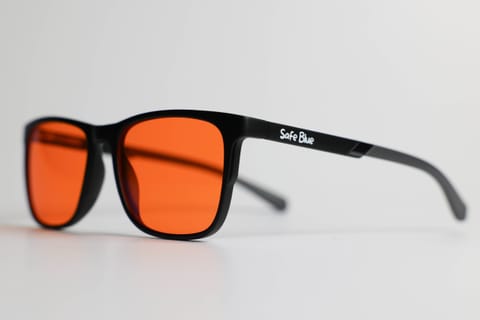
The high-filtration category: blocking of 95–100% of the 400–500 nm band, with a “cutoff” (the wavelength below which the lens blocks almost everything) between 500 and 550 nm. Here colours change for real — blue disappears, everything turns warm — so these are glasses designed for the evening hours or for those who give absolute priority to screening, not for photo editing. If you want to understand the perceptual differences in detail, we have analysed them in orange vs clear lens.
| Category | Typical blocking at 450 nm | Colour rendering | Typical use |
|---|---|---|---|
| Clear | 10–25% (premium: more on the violet) | Unchanged | Office, video calls, all day |
| Light amber | 40–65% | Slightly warm | Gaming, long daytime sessions |
| Orange/red | 95–100% (400–500 nm) | Strongly warm | Evening, maximum screening |
None of the three categories is “the best”: they are different tools. An orange lens worn in a client meeting is out of place; a clear lens used to screen out evening blue light is, the numbers in hand, little more than an optical placebo.
The objective criteria for judging a pair of glasses
When we compare models and brands, we always look at the same six variables. They are the same ones we advise anyone to check, on any site, and that we examine point by point in the choosing guide:
- Blocking percentage per nm range. “Blocks blue light” means nothing. “Blocks 99% between 400 and 500 nm” means everything. A serious maker publishes the numbers per band; an evasive one writes “up to” before the percentage or cites only the 400–420 nm band, where it is easy to get high values even with almost clear lenses.
- Visible light transmission (VLT). How much total light passes through the lens. Below 40–50% the lens becomes uncomfortable in poorly lit spaces; well-designed evening work lenses sit between 55% and 75%.
- Lens material. CR-39 (organic resin) and polycarbonate dominate the market: the first has excellent optical quality for the price, the second is more impact-resistant. Glass is rare and heavy; the cheap acrylic lenses of marketplaces are the main warning sign.
- Real certifications. CE marking as eyewear (PPE regulation), UV400 filter, and any references to standards such as EN ISO 12312-1. Note: CE marking attests to general safety requirements, not the blue light filtering percentage — that must be demonstrated with a transmission spectrum.
- Build quality and fit. Weight under 30 grams for prolonged use, screwed hinges (not pressed), adjustable temples or a geometry that does not pinch behind the ears.
- Purchase terms. Actual returns, warranty, availability of spare parts. On products between €50 and €120, a 30-day returns window is now the standard among serious brands.
Anyone who does not publish point 1 does not deserve your time, however nice the site. And if you want to check a pair you already own, we have written a guide on how to test blue light glasses.
The brands worth knowing in 2026
Gunnar Optiks — the gaming veteran
Active since 2006, Gunnar is the historic name of the category, born even before “blue light” became an e-commerce keyword. Concrete strengths: filtering declarations per band with its own scale (GBLF), the verifiable figure of 65% blocking at 450 nm on the Amber lenses, frames designed for gaming headsets and availability of prescription lenses. The aesthetic is “gamer”, which you may like or not. Indicative price band: medium-high, around €60–120 depending on the model.
Who it suits: gamers and users who want a documented intermediate filtration, with a mature ecosystem of models and prescription variants.
Felix Gray — the premium office option
Felix Gray has built its reputation on elegance: quality acetate frames, lenses with the filter built into the material (not a simple surface coating) and a buying experience worthy of an eyewear brand, not a tech gadget. The clear lenses declare a filtration above the category average; for the evening there is a stronger amber line. The absolute figures per band, however, are communicated less granularly than by others. Premium band, indicatively above €100.
Who it suits: professionals who want glasses that are nice to wear all day in formal settings and accept moderate filtration as a trade-off for transparency.
Bon Charge (formerly BluBlox) — the evening-wellness maximalist
Bon Charge, founded as BluBlox in Australia, is the reference for extreme filtration: red and orange lenses with a stated total blocking of the blue band (and in some models of green too, up to ~550 nm), designed for the hours before sleep. The brand has grown into an ecosystem of wellness products, with marketing that is more “lifestyle” than optical. The lens quality is serious; the prices are in the international premium band, indicatively €80–150 plus customs and shipping from abroad for someone buying from Ireland.
Who it suits: those looking for the most aggressive evening screening possible and not minding the cost, accepting international shipping times and charges.
Pixel Eyewear — the well-made clear option
Pixel Eyewear has specialised in almost-clear lenses with filtration declared on the 400–440 nm band and a slight, barely perceptible tint. Clean design, mid-range prices (indicatively €50–80), good returns policy. Like all clear lenses, the blocking on the 450 nm peak remains structurally limited: it is a product for daytime comfort, not for evening screening.
Who it suits: those who want discreet desk glasses, with colour rendering intact, and consider strong filtration a non-goal.
Pharmacy and marketplace glasses
Below €20–25 you find everything: rest glasses with a generic filter sold in pharmacies, marketplace multipacks with “anti blue light” printed on the box. Some filter something on the violet; almost none publish a transmission spectrum; many disappoint in practical tests. They are not necessarily a scam — as neutral glasses with a UV filter they can make sense — but they should be bought for what they are: a few-euro experiment, not a documented solution. We talk about it in detail in the analysis of the market price bands.
| Brand | Lens category | Data per nm band | Price band | Ideal profile |
|---|---|---|---|---|
| Gunnar | Amber (and clear) | Yes, GBLF scale + figure at 450 nm | Medium-high | Gamers, intense daytime use |
| Felix Gray | Clear (and amber) | Partial | Premium | Office, aesthetics first |
| Bon Charge | Orange/red | Yes, stated total blocking | Premium import | Maximum evening screening |
| Pixel Eyewear | Almost clear | Yes, on 400–440 nm | Medium | Desk, colours intact |
| Pharmacy/marketplace | Variable | Almost never | Low | Low-cost experiment |
| SAFEBLUE | Orange | Yes, 99% on 400–500 nm | Medium | Evening and intensive sessions |
Where SAFEBLUE fits (and who it is NOT for)
Let us repeat the premise: here we stop being observers and become a party with a stake. Here are the numbers, which are worth more than opinions.
SAFEBLUE Classic fits an orange lens with measured blocking of 99% in the 400–500 nm band and 85% in the 500–530 nm band, with a cutoff at 530 nm. Visible light transmission is 65%: higher than the average of aggressive orange lenses, which makes it usable even in normally lit rooms without the “indoor sunglasses” feeling. It costs €49.90, with free shipping over €80, 30-day returns and a 2-year warranty. It is not a medical device and we do not present it as one.
Our positioning bet is simple: bring the numbers of the premium band (Bon Charge, to be clear) to a mid-range price, with local shipping and returns.
And now the part that e-commerce sites usually leave out. SAFEBLUE is not for you if:
- You need faithful colours. Designers, photographers, video editors: with a lens that cuts everything below 530 nm, blue no longer exists. For colour work you need clear lenses (Pixel, Felix Gray) or no lens.
- You want glasses that are invisible in the office. The orange lens is noticeable, and in a formal meeting it can come across as eccentric.
- You wear prescription glasses and want an integrated solution. We do not offer prescription lenses: in that case, Gunnar with a prescription is better, or talk to your optician.
- You are after a filter “just to try”. If your budget is €15, a pharmacy pair is a legitimate entry point; our product would make little sense.
If, on the other hand, your use case is the evening hours in front of the screen, long work or study sessions and the highest documented filtration in the 400–530 nm band, then our numbers stand up to anyone — and it is a comparison we invite you to make line by line.
What the research actually says (spoiler: it depends on the lens)
It would be easy to close with “science confirms it”. We will not, because the picture is more nuanced.
The 2023 Cochrane review (17 randomised studies, DOI 10.1002/14651858.CD013244.pub2) assessed blue light filtering lenses and concluded that, compared with ordinary lenses, the tested lenses probably produce no short-term difference in screen eye strain. An important and often-omitted point: the included studies concerned almost exclusively low-filtration clear lenses (that 10–25% above), and the authors themselves note the uncertainty of the results on sleep and other outcomes.
On the light-and-biological-rhythms front, Harvard Health documents that evening exposure to blue light suppresses melatonin more markedly than other wavelengths. It is a fact about light, not about glasses: how much a filter worn in the evening affects these mechanisms is the subject of studies with mixed results, generally more interesting for amber/orange lenses than for clear ones — but it is not demonstrated conclusively.
Our position: buy filtering glasses for what they do physically (block a measurable band of light) and for the perceived comfort you yourself notice, not for promises of guaranteed benefits. The American Academy of Ophthalmology points out that for screen discomfort, breaks, distance and blink rate also count a great deal — glasses are no substitute for good habits.
Frequently asked questions
What is the best blue light glasses overall?
There is none. Clear, amber and orange lenses serve different purposes: discreet office comfort the first, a daytime compromise the second, maximum (typically evening) screening the third. The “best” is the one whose transmission curve matches your use case. Be wary of any ranking that proclaims a single winner without specifying blocking band and use context.
Do clear lenses really block blue light?
Only minimally. Most filter 10–25% around 450 nm, where screens emit most; some do better on the violet (400–440 nm). It is physics: to stay clear, a lens must let blue through, which is part of visible light. If the goal is substantial screening, you need an amber or orange tint.
Are the €15 pharmacy glasses worth anything?
As neutral glasses with a UV filter, often yes. As blue light filters, they almost never document their own performance: no transmission spectrum, no percentages per band. They can be a low-cost experiment, but do not expect the numbers of a specialised product. At least check for CE marking and a UV400 filter on the box.
Gunnar or SAFEBLUE: which to choose?
It depends on the goal. Gunnar (amber lens, 65% at 450 nm) is more versatile during the day and offers prescription variants: for a gamer playing in the afternoon it is a sensible choice. SAFEBLUE Classic blocks 99% on 400–500 nm with an orange lens: it makes sense for the evening and for those who want the highest filtration possible. We are biased, but the two transmission curves tell, on their own, the story of two different products.
Why do some orange lenses cost three times as much as others?
The real differences lie in: optical quality of the lens (distortions, tint uniformity), filter in the material rather than in a surface coating that wears off, frame, certifications and sales channel (non-EU import adds customs and shipping). Above a certain threshold you also pay for the brand: the full analysis is in our article dedicated to price, linked above.
Can I use blue light glasses over contact lenses?
Yes, with no technical contraindication: contact lenses correct vision, the filtering glasses screen the light band. It is in fact the simplest combination for someone with a vision defect who wants an orange lens, given that few makers offer prescription orange lenses.
Does CE marking guarantee that the glasses filter blue light?
No. CE marking attests to conformity with general product safety requirements, not the blue light filtering percentage. A pair of glasses can be perfectly CE marked and filter almost nothing in the 400–500 nm band. The only document that demonstrates the filtration is the measured transmission spectrum, ideally from a third-party laboratory.
Are blue light glasses useful during the day too?
The most solid rationale concerns the evening, when blue light interferes with melatonin production, as documented by Harvard Health. During the day, use is a matter of personal comfort: many amber lens users report a more restful view in front of the screen, but the scientific evidence on measurable daytime benefits is weak: the personal-comfort rule applies, verified with a returns window in hand.
In short
The 2026 blue light glasses market is understood with a single question: “how much do you block, and in which band?”. Clear lenses (Felix Gray, Pixel Eyewear) offer discretion and intact colours with modest filtration; amber ones (Gunnar) a documented daytime compromise; orange ones (Bon Charge, SAFEBLUE) the almost total screening of the blue band, at the price of a view turned warm. Pharmacy glasses remain a cheap experiment without data.
We play in the orange category, and our numbers are public: 99% blocking on 400–500 nm, 85% on 500–530 nm, 65% visible transmission, €49.90, 30-day returns, 2-year warranty. If your use case is the right one — evening, long sessions, filtration as the priority — go ahead and compare them with anyone else in the table. If, on the other hand, you need something else, you now know exactly where to look: it is the reason this guide exists.
Sources
- Cochrane Database of Systematic Reviews — Blue-light filtering spectacle lenses (2023)
- American Academy of Ophthalmology — Are Blue Light Blocking Glasses Worth It?
- Harvard Health Publishing — Blue light has a dark side
- GUNNAR Optiks — official site
- Felix Gray — official site
- Bon Charge — official site
This article is for information only and does not constitute medical advice. See a qualified optometrist for any vision concerns. SAFEBLUE is a visual comfort accessory, not a medical device.
Related articles
Blue Light Glasses Price: Real Market Tiers in 2026
What blue light glasses actually cost: €10-20 on marketplaces, €30-60 mid-range, €70-100+ premium. What you really pay for, and the low-cost traps.
How to Choose Blue Light Glasses: Criteria and Data to Ask For
Blocking percentages per nm range, CR-39 or polycarbonate, visible transmission, CE and UV400: the concrete criteria for choosing blue light glasses.
Orange vs Clear Lens: The Real Differences
Transmission spectra, blocking percentages and colour rendering: the technical comparison between orange and clear lenses, to work out which suits you.
How to Test Blue Light Glasses: Do They Really Filter?
Blue pen, spectrophotometer, RGB screen: the reliable tests and the misleading ones for checking how much your blue light glasses really filter.