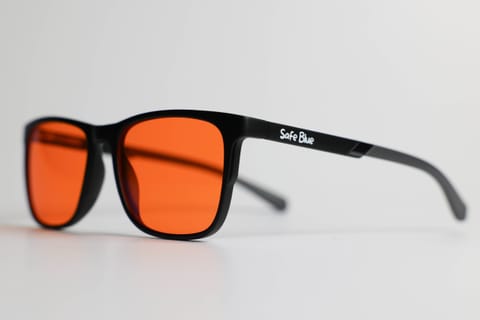
Glasses for Designers: When (Not) to Use an Orange Lens
Glasses for designers: why an orange lens has no place in colour work, when it makes sense anyway, and the serious alternatives: a calibrated monitor and D65.
· 14 min read
This is probably the most counterintuitive guide you will read on this site, and it is written by the brand that sells the orange-lens glasses. If you are a graphic designer, photographer, video editor or art director searching for “glasses for designers” to wear in front of the monitor while you work, the honest answer fits on one line: during any colour work, a high-filtration orange lens must not be worn. Ever. A lens that cuts almost all of the 400 to 500nm band imposes a warm cast on the entire scene that no amount of habit can truly cancel: every colour judgement made through that filter is a skewed judgement. For an accountant it is a detail; for you it is the craft.
So why write a guide about glasses for designers at all? Because a creative’s day is not made of colour alone. There are briefs to read, client emails, invoices, greyscale wireframes, hours of writing and research. And above all there is the evening, when the work is done but the screens are not. This guide draws the boundary precisely: in colour-critical hours the serious tools are called a calibrated monitor, controlled lighting and breaks — and we will walk you through them in detail, even though we do not sell them. In text phases and after sunset, on the other hand, the orange lens goes back to being a sensible tool. Let us see why, with the physics in hand.
Why an orange lens skews colour judgement
Let us start with the numbers, the same ones we state on the product page. A high-filtration lens like ours blocks 99% of light between 400 and 500nm and 85% between 500 and 530nm, with a 530nm cutoff and an overall visible-light transmission of 65%. Translated into the language of people who work with colour: violets and blues reach the retina at 1% of their intensity, cyans almost vanish, cold greens shift towards yellow. A #0033FF button becomes a near-black smudge; the difference between cobalt blue and navy — the one you argued about with the client for half an hour — simply no longer exists.
But the most insidious problem is not what you see: it is what your brain does to compensate. It is called chromatic adaptation, and it is the same mechanism by which a sheet of white paper looks white both in sunlight and under a warm bulb. After ten minutes with the lens on, the perceived white point “renormalises”: the scene no longer looks so orange to you, and you convince yourself you can judge. It is an illusion, and it works against you in a predictable way: if you retouch a skin tone through a warm filter, you will tend to correct towards cold to counter the cast you no longer perceive. Take the glasses off, reopen the file the next day, and everything has shifted to cyan. Anyone who has done colour correction with the wrong white balance in the control room knows this exact mistake.
To be clear: this is not a flaw in the lens. It is its declared behaviour. A filter that removes an entire band of the spectrum and colour fidelity are incompatible by definition, and anyone selling you “blue light glasses for designers that do not alter colours” is selling you either a filter so mild it is irrelevant, or a physical contradiction. We have a whole piece on what you actually see through an orange lens: for a designer it is required reading before the purchase, not after.
The jobs where colour is the product
“Colour work” does not just mean colour grading in DaVinci. The list of activities where the filter has to come off is longer than it seems:
Photo retouching and RAW development. White balance, skin tones, toning, split toning: all pure colour judgement. Even “simple” exposure runs through colour perception.
Video colour grading. Rec.709, LUTs, matching across different cameras: the colourist works in controlled-lighting rooms precisely because they know how much context shifts perception. Adding an orange filter between eye and reference monitor is the exact opposite of everything the discipline teaches.
Brand identity and prepress. Choosing a Pantone, signing off a proof, checking a soft proof: here the mistakes land at the printer, multiplied by ten thousand copies. The graphic arts industry has codified standardised viewing conditions (D50 viewing booths, ISO 3664) precisely because colour judgement is fragile even without a filter on your nose.
UI and product design. A design system’s palette, WCAG contrast, hover and error states: the semantic reds and greens stay distinguishable through the lens (we explain this in the guide for programmers too), but their perceived quality — saturation, temperature, harmony with the brand — is altered. Deciding a palette with the lens on is like choosing wine with a head cold.
Social content and presentations. “They will be seen on a thousand different uncalibrated screens anyway” is the classic objection. Half true: precisely because you do not control the audience’s screens, the one fixed point in the pipeline has to be your neutral reference. If even that is filtered, the error has no limit.
The same logic, incidentally, applies to software filters: Night Shift, f.lux and Windows night mode must be switched off during these phases, as any retoucher knows. The full comparison between the two solutions is in night mode vs glasses — spoiler: for colour-critical work both are wrong.
The serious alternatives for colour-critical hours
If your problem is the eight daytime hours in front of Photoshop, the answer is not a filter: it is the colour chain and the ergonomics of your desk. In order of impact:
A calibrated monitor, properly. A decent colorimeter costs £130 to £220 and should be used at least once a month, not once in a lifetime. Reasonable targets for screen work: a D65 white point (D50 if you do soft proofing for print), 80 to 120 cd/m² luminance in a home or studio environment, an average ΔE below 2. If the budget allows, a hardware-calibration monitor (EIZO ColorEdge, BenQ SW, ASUS ProArt) removes the approximations of graphics-card calibration. It costs ten times our glasses and, for your trade, is worth ten times as much: we write that without mincing words.
Controlled, constant ambient lighting. The best monitor in the world is useless if at 10am you work with the sun in your face and at 5pm in the dark. The rule: neutral ambient light (4000 to 5000K for anyone working with print, consistent with the monitor’s white point), stable and moderate intensity, no coloured sources reflecting off the panel, neutral walls behind the monitor where possible. A 6500K bias light behind the screen stabilises perceived contrast in evening sessions. Windows have to be managed: perpendicular to the screen, with technical blinds if needed.
A neutral working environment inside the screen too. A medium-grey desktop background, software interfaces in a neutral dark theme, no saturated wallpaper next to the file you are judging. These are details every colourist knows and that cost nothing.
Breaks and blinking. The American Academy of Ophthalmology notes that in front of a screen we blink 5 to 7 times a minute against the normal 15, and that a fixed distance and a screen too bright relative to the room are the first causes of screen discomfort. The 20-20-20 rule (every 20 minutes, 20 seconds looking six metres away) hooks well onto a designer’s dead time: export, rendering, upload. No lens — orange or clear — acts on focusing or blinking: on this point the 2023 Cochrane review, which examined 17 randomised studies on clear filtering lenses, found no evidence of benefit for short-term eye strain. We say it before you find out: daytime comfort is built with your desk, not with a purchase.
Panel warm-up. A pro detail: many monitors take 20 to 30 minutes to stabilise in luminance and colour temperature. Fine colour decisions are made on a warmed-up panel.
When glasses make sense even for a designer
With all that said, a creative’s day contains plenty of hours where colour does not come into it. And it is there — plus the evening — that an orange lens finds its legitimate place.
Text and structure phases. Writing a concept, answering emails, preparing a quote, reading a contract, doing project management on Notion or Trello, sketching greyscale wireframes, researching and reading documentation: in all of these, colour judgement is irrelevant and the screen is mostly text. If these phases fall in the late afternoon or evening — for many freelancers that is the norm — the filter takes nothing away from the work.
The evening after work, always. Here the discussion changes nature: we are no longer talking about productivity but about circadian rhythms. Research reported by Harvard Health measured that evening blue light suppresses melatonin for roughly twice as long as green light of the same intensity, shifting circadian rhythms by 3 hours versus 1.5. ANSES, the French health-safety agency, explicitly recommends limiting exposure to intense blue light in the evening hours, particularly from screens. A designer comes off eight hours of monitor and often does another three between TV series, social media and other people’s portfolios: it is exactly the use window a high-filtration lens was made for. The paradox of your trade is right there: the same characteristic that makes the lens unusable at 11am — the sharp cut of the blue band — is what makes it interesting at 10pm, when nobody cares about the colour fidelity of Instagram.
The evening side project, with judgement. Cutting the rough of a personal project, writing the blog, sorting the archive: all fine with the lens on, until you touch a colour decision. The discipline is simple: if the question is “what colour?”, the lens comes off and it waits until morning.
If you are wondering why not just a clear lens to keep on by day too: for colour work it is still one more variable between eye and monitor, and for comfort the evidence of effectiveness — Cochrane, again — is not there. The full comparison is in orange vs clear lens; the short version is that a clear lens is no use for your daytime problem and not enough for your evening context.
A typical designer’s day (with the boundary in the right place)
Marta, 34, a freelance brand and visual designer, home studio, one calibrated 27-inch monitor plus the laptop.
8:40am — Switch-on and coffee. The monitor warms up while she clears email from the laptop. No filtering glasses: it is morning, the room is bright, daytime blue light is physiological.
9:15am to 1pm — Colour-critical block. A palette for a rebrand, retouching the product photos, export for print. Technical blinds adjusted, constant ambient light, Night Shift off, grey desktop background. The orange glasses are in the drawer, and that is where they stay. A look into the distance at every export.
2pm to 4:30pm — More colour, then layout. The soft proof for the printer demands maximum neutrality: warmed-up panel, no filter, comparison against the paper under neutral light. At 4pm she moves to laying out a 40-page document: here the colour is already decided, but she keeps the neutral setup for consistency.
4:30pm to 6:30pm — Admin and calls. Invoices, email, a client call, the week’s editorial plan. From here on, colour judgement is closed for the day: if the session stretches into the evening, the glasses come out of the drawer. On calls they show — the orange lens does not go unnoticed on a webcam — but with regular clients it has become an anecdote, not a problem.
7:30pm to 11pm — Evening. Dinner, then a couple of hours between a TV series and scrolling Behance and Instagram. Glasses on from start to finish: TV, tablet and phone are three different screens and the physical filter covers all three without configuring anything. The irony of looking at other people’s work with a warm cast does not escape her: but at 10pm she is consuming, not judging.
The pattern to copy is not the hours: it is the drawer. Marta’s glasses have a clear physical place and a clear time boundary, and the boundary is not set by tiredness but by the type of activity: colour = never; evening text and after-hours = yes.
Frequently asked questions
Are there glasses for designers that do not alter colours?
No, if by “glasses for designers” you mean an effective blue-light filter. Any lens that significantly attenuates the 400 to 500nm band shifts the colour rendering: it is physics, not marketing. Near-clear lenses alter little but filter little (and for visual comfort the evidence of benefit is not there, as the 2023 Cochrane review shows); orange lenses filter genuinely but transform the scene. For colour work the right answer is no filter and a calibrated monitor.
Can I use the orange lens if I only work in black and white?
Almost. Layout and greyscale wireframes survive the filter well. But serious black-and-white photo retouching is a judgement of luminance and fine tones, and a lens that transmits 65% of visible light with a strong spectral imbalance alters that too. For layout yes, for fine art no.
Are Night Shift and f.lux an alternative for daytime work?
No: they have the exact same problem, a warm cast that skews judgement. During colour-critical phases those have to be switched off too. The difference between software filters and glasses concerns the evening, not the colour-work hours.
How long do the eyes take to return to neutral after taking the lens off?
Chromatic adaptation largely resettles within a few minutes, but professional caution suggests more: do not make fine colour decisions in the following 15 to 20 minutes, and never compare “from memory” something seen with the lens against something seen without. If you have spent the evening with the glasses on, the colour decisions are made in the morning.
Doesn’t a calibrated monitor make the glasses pointless?
They are tools for different problems. Calibration serves colour accuracy during work; the orange lens serves to filter the blue band of screens in the evening hours, when you are no longer judging colour. A professional designer can reasonably want both — and use them in strictly separate moments.
Won’t the orange lens tire my eyes more, since it darkens the screen?
A 65% visible transmission roughly equals turning brightness down by a third: in the evening, in a home environment, that is if anything the right direction, because the screen “blasts” less in the dark. By day, in a bright room, it is one more reason not to wear it: the screen would look dim relative to the surroundings.
For an amateur photographer, does the same reasoning apply?
Yes, in proportion. If you develop your holiday photos on a Sunday afternoon, prepress rigour is not needed; but the principle stands: when you adjust white balance and colours, the filter comes off. The difference is that an amateur can afford to postpone the retouching to a daytime slot and use the glasses for everything else.
Traders look at charts all day: does the same rule apply to them?
No, and it is an instructive comparison: a trader’s “charts” are red and green candles where the distinction matters, not the fidelity — and through the lens the distinction stays intact. That is why in the guide for traders the recommendations are far less restrictive than in this one. The rule is not “anyone who looks at screens”, it is “anyone who judges colours”.
So why does a glasses brand write a page that advises against its own glasses?
Because a disappointed customer’s return costs more than a missed sale, and because a designer who buys the lens knowing exactly when to use it — evening and text phases — is a customer who keeps it. We would rather tell you ourselves where the tool does not work than let you find out on a skin tone shifted to cyan.
In short
If you work with colour, the orange lens is your worst tool during the work and one of your most sensible afterwards. In colour-critical hours, invest where it really counts: a calibration device, a monitor worthy of your pipeline, neutral and constant lighting, breaks hooked to exports and rendering. No lens holds up there, and anyone who tells you otherwise has never delivered a file to a printer. From the moment you close the files onwards — evening emails, wireframes, and above all the hours of screen after dinner — the picture flips: there, a physical filter that cuts 99% of the 400 to 500nm band across all your screens has a solid logic, documented by the research on circadian rhythms.
SAFEBLUE Classic costs €49.90 with returns within 30 days: enough to try it over a few weeks of evenings and admin phases and see whether the colour/non-colour boundary holds in your real day. SAFEBLUE is a visual comfort accessory, not a medical device, it does not replace calibration and it will not get your delivery out sooner: it is an evening tool with a precise job, and now you know exactly what that is.
Sources
This article is for information only and does not constitute medical advice. See a qualified optometrist for any vision concerns. SAFEBLUE is a visual comfort accessory, not a medical device.
Related articles
Glasses for Programmers: A Guide to Visual Comfort
Glasses for programmers with an orange lens: dark mode, 2-3 monitors, late code reviews. Setting up your desk, the real limits, and when you don't need them.
Glasses for Traders: Multi-Monitor, Candles & US Sessions
Orange-lens glasses for traders: 4-6 monitors, red/green candles still readable but altered, evening sessions on the US markets. An honest guide.
Do orange lenses make everything look orange?
Yes, there's a warm cast. But your visual system adapts: when you stop noticing it, when it stays a problem and when it doesn't. The honest answer.
Orange vs Clear Lens: The Real Differences
Transmission spectra, blocking percentages and colour rendering: the technical comparison between orange and clear lenses, to work out which suits you.