Glasses for Traders: Multi-Monitor, Candles & US Sessions
Orange-lens glasses for traders: 4-6 monitors, red/green candles still readable but altered, evening sessions on the US markets. An honest guide.
· 14 min read
There is one question every trader asks before buying orange-lens glasses, and that almost no seller tackles head-on: “will I still be able to tell red candles from green ones?” It is the right question, because for someone who trades, colour is not decoration, it is operational information. And the honest answer — the one you will read below, with the physics to back it up — is: yes, they stay distinguishable, but both altered. Green shifts towards olive tones, red stays red but warmer. The directional distinction survives; colour fidelity does not.
We start from this premise because the rest of the article only makes sense once that point is clear. The battlestation of a serious retail trader — four, five, six monitors lit, TradingView on two screens, the order book, the DOM, the catalyst feed on Twitter/X, the broker’s platform — is one of the highest light-emitting setups a private individual can have at home. And the timing makes everything worse: anyone following the US markets from Ireland or continental Europe is at the desk from mid-afternoon until late evening, with the hottest part of the session (the last hour, the power hour) falling long after dark, and perhaps carrying on with the after-hours and watchlist prep until midnight.
In this guide: how much light a wall of monitors really produces, what exactly happens to candles and heatmaps behind a lens with a 530nm cutoff, when an orange lens is the wrong call for a trader, and how to organise the US session so you do not sabotage the night.
The wall of monitors: how much light really reaches you
Let us do some rough but honest sums. A 27-inch monitor at medium office brightness emits in the order of 120 to 200 nits across much of its surface. A six-monitor setup means multiplying by six a source that, on its own, already dominates the field of view in the evening. And trading platforms do not help: even in dark mode, a TradingView layout is dotted with saturated elements — bright green candles, blue indicator lines, yellow alerts, the white of the volumes — that the eye jumps across constantly.
Unlike the programmer, who fixes on the same spot for long stretches, the trader does continuous scanning: from the 5-minute chart to the daily, from the book to the news feed, from one screen to another with micro-saccades for hours. Every jump is a readjustment. Add that during active trading, tension reduces blinking further still — the American Academy of Ophthalmology documents how screen concentration markedly lowers blink rate, and it is hard to imagine a tenser screen task than an open position on the Nasdaq on a CPI day.
Typical result at the end of a session: dry eyes, that “sand” feeling, difficulty refocusing on distant objects when you get up from the desk. If that sounds familiar, we have catalogued these signs in the piece on the signs of digital eye strain. It is important to be clear: on these mechanisms — blinking, prolonged focus — a tinted lens does not act. It acts on something else: on the spectral composition of the light hitting you across a six-and-a-half-hour evening session. Let us see how.
Red and green candles with an orange lens: the truth
Here is the part you actually care about, explained with physics and not with marketing.
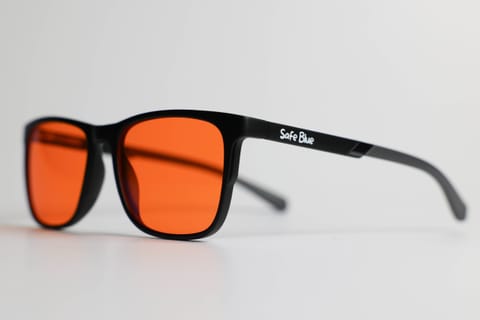
A high-filtration orange lens like SAFEBLUE’s has a 530nm cutoff: it blocks 99% of light between 400 and 500nm (blue) and 85% between 500 and 530nm (blue-green), letting through 65% of overall visible light. Now let us look at where your candle colours “live”:
- Red sits around 620 to 700nm: well above the cutoff. It passes almost entirely. Red candles stay red, if anything slightly warmer and brighter relative to the rest.
- The green of charts is typically a digital green emitting between 500 and 560nm, with monitors producing it by mixing the green subpixel (peaking around 530 to 550nm). The portion below 530nm is cut, the portion above passes through: the perceived result is a darker green, shifted towards olive/yellowish.
- Blue (indicator lines, light-blue EMAs, UI elements) pays the highest price: it darkens drastically, to the point of looking dark greenish-grey.
Translated into practice: red and green stay two clearly different colours — one warm and bright, one dark and olive — so reading the direction of a candle, of a ticker changing colour, of a positive or negative P&L stays immediate. What you lose is the “brochure” rendering: bright green is no longer bright, and if your indicators rely on fine gradations (light green vs dark green for volume intensity, gradients in heatmaps) those gradations compress.
Two practical consequences and one piece of advice:
- Heatmaps and sector maps (the Finviz map, red-to-green gradients): they stay legible in direction, less legible in intensity. If your trading depends on telling “+0.5%” from “+2%” at a glance from the shade of green, that granularity narrows with the lens.
- Alerts and custom encodings: if you have Pine scripts with four shades of green, simplify the palette or increase the luminance separation between levels.
- The advice: try the lens outside trading hours first — a weekend on the TradingView replay — so you can check it on your platform and your colours, with no money on the table. And you have 30 days to return it anyway: the definitive test is on your own battlestation.
US session from mid-afternoon to late evening: the real problem is afterwards
Let us talk about the elephant in the trading room. For a trader in Ireland or continental Europe on the American markets, the closing bell rings late in the evening, local time. The power hour — often the most active, most adrenaline-fuelled moment of the day — comes in the last hour before the close. Then perhaps there is the after-hours with earnings, the day’s journaling, prepping tomorrow’s watchlist. Realistically, the screens go dark somewhere between 11pm and midnight.
This is exactly the scenario where the research on evening light is most solid. Studies cited by Harvard Health have shown that blue-light exposure in the evening suppresses melatonin production with roughly twice the intensity of green light at the same brightness, and shifts circadian rhythms by about double (roughly 3 hours versus 1.5). Nobody needs a study, though, to recognise the pattern: a late close with adrenaline in the body, a couple of hours of scrolling and mental replays of the session, sleep that will not come. Evening trading combines the two worst ingredients: high-blue-content light and emotional activation.
What an orange lens can do here — said with surgical precision: it physically filters 99% of the 400 to 500nm band from every screen in your evening session, from late afternoon onwards. It is the only intervention that simultaneously covers six monitors, the phone with the broker app and the telly with CNBC in the background, without touching the colours your stream followers (if any) see and without depending on the software support of each panel. We cannot tell you that you will sleep better — that would be a promise current science does not authorise and that the rules rightly forbid. We can tell you that many of our trader customers wear them systematically from late afternoon to the close, and that the physical rationale (less circadian band in the eyes during the hours that matter) is solid. The rest you decide for yourself, with your 30-day trial. For the full picture on the mechanism, read blue light and sleep.
One addition that has nothing to do with glasses but needs saying: the “buffer” between bell and pillow. Journaling on paper rather than on screen, a watchlist prepared right after the close and not at midnight, no replaying the session in bed. The lens filters light, not adrenaline.
When an orange lens is NOT the right call for a trader
As in every one of our guides, the section traditional marketing would leave out.
1. If your trading is built on fine shades of colour. We said it above but we will repeat it from an uncomfortable position: order flow with continuous-gradient heatmaps (Bookmap and the like), strategies that read colour intensity and not just direction, dashboards with multi-shade encodings. In these cases the colour compression of the orange lens touches operational information. Options: redesign the palette with sharper luminance separations, or a light, low-filtration lens, accepting the opposite trade-off — almost no filtering in exchange for faithful colours. The comparison is in orange vs clear lens.
2. If you have a red-green colour deficiency. Around 8% of men have altered perception on exactly the red-green axis. If you are one of them you have probably already configured alternative palettes (many platforms support colourblind-friendly blue/orange schemes); be careful, though, because the orange lens heavily penalises precisely the blue in those schemes. Test cautiously before using it in live trading.
3. During the European session or the morning. Milan and Frankfurt open at 9am, with full daylight outside the window. In those hours the orange lens is out of context: the daytime blue band is physiological and — per the literature on alertness Harvard cites — useful for alertness, which for a trader is not exactly a minor detail.
4. If you expect effects on dry eye or focus discomfort. The 2023 Cochrane review on filtering lenses found no evidence of benefit for short-term digital eye strain, and the AAO’s position is that screen discomfort comes from blinking and focusing, not the blue band. On that front the tools are different: the 20-20-20 rule (a look out of the window at every timeframe change), humidification, breaks in the dead moments of the pre-market. Orange glasses are an evening and spectral tool, not a universal remedy — and they are not a medical device.
How to set up the multi-monitor desk
Before the glasses, or alongside them, the desk. For a 4 to 6 screen setup there are three critical points:
Brightness hierarchy. Not every monitor deserves the same brightness. The main trading screen (chart + DOM) in the centre, at full brightness but calibrated to the room; the surrounding screens (news, Twitter/X, Discord, scanner) 20 to 30% lower. The eye always returns to the centre: the periphery should inform, not compete.
Bias light behind the wall of monitors. With six panels lit in a dark room, the screen-to-wall contrast is brutal. A warm-white LED strip behind the central monitors softens the transition and costs about as much as an overnight fee. The AAO explicitly recommends balancing screen brightness against ambient brightness.
Distances and angles. The side monitors of a curved setup often end up too close to the eyes (under 50cm). Rule of thumb: every screen at least an arm’s length away, the ones where you read fine text slightly closer than the “traffic-light” ones you only glance at.
On this base, the orange glasses come in as a final layer for the evening time slot: from late afternoon until shut-down, every night of the US session.
A typical day for a retail trader on the US markets
Andrei, 35, trades US equities and futures, a part-time start that became his main activity. Five monitors, working from home, on Irish time.
8:30am to 10am — Macro and coffee. Overnight check on the futures, economic calendar, news. Natural light, no filters: it is morning, the eyes and brain need to switch on, not off.
10am to 2pm — Study and backtests. Analysis, replay, updating the journal. Screens at daytime brightness. 20-20-20 rule hooked to activity changes. It is also the window to train on the platform with the orange lens if he is considering adopting it: better to find out how it renders his palette in backtest than in a live position.
2pm to 2:30pm — A real break + pre-market. Lunch away from screens, then watchlist and trading plan: levels, scenarios, size.
2:30pm — The bell. New York opens. The first half hour is high-intensity, maximum concentration. There is still light outside; no filtering glasses.
5pm to 6pm — The belly of the session. Volumes dropping, position management. Andrei gets up, looks out of the window, takes a couple of steps. It is the moment when, in winter, the sun has already set.
6:30pm — Evening switch. Orange glasses on, brightness on the five monitors down a notch, bias light on. The green candles shift to olive — after two weeks he no longer notices, the directional read is identical. He has swapped the indicator blue for a light yellow in his TradingView settings: two minutes of configuration, problem solved.
8pm to 9pm — Power hour. The most active moment of the day, with filtered screens. Reds and greens perfectly distinguishable, P&L legible, zero latency because — obviously — a lens has no latency.
9pm to 10pm — Close and journaling. Flat on the positions, journal filled in on paper, tomorrow’s watchlist sketched out straight away. Glasses still on for the last round of the phone. Then black screens and, ideally, a book that is not about markets.
Frequently asked questions
With an orange lens, can I still tell red candles from green ones?
Yes. Red (620 to 700nm) passes the 530nm cutoff almost entirely; the monitors’ green passes partially and shifts towards dark olive. The two colours stay clearly different from each other, so the directional read is immediate. What you lose is the brightness of the green and the fineness of the shades in gradients.
And heatmaps like Finviz or Bookmap?
Legible in direction (red vs green), compressed in intensity (faint green vs bright green). If your trading depends on fine gradients, you are in the “when not to use it” case: consider a palette with greater luminance separation or a light lens.
Does the indicator blue disappear?
Almost: it is the most-filtered band (99% between 400 and 500nm). Light-blue EMAs and blue lines become dark and barely legible. A two-minute fix: in the platform settings, move the blue indicators to yellow, orange or white. Most traders do this once and never think about it again.
Can I wear them for the whole US session, from mid-afternoon?
You can, but the rationale only kicks in from the evening. At 2:30pm on an afternoon there is full daylight: the blue band is physiological and useful for alertness. The sensible usage pattern is to wear them from sunset (around 5 to 6pm in winter, later in summer) until the end of the day.
Do they work on the broker app on the phone too?
Yes, and it is one of the key advantages for a trader: the lens filters any screen — the six monitors, the phone you check positions on from the sofa, the tablet, the telly with CNBC. No per-device configuration, no software filter to sync.
Do they add latency to the book or DOM display?
No, zero by definition: it is a passive optical filter, there is no processing of any kind. Light passes through the lens, full stop. Any comparison with software filters starts here.
Exactly how much do SAFEBLUE lenses filter?
The headline numbers: 99% blocked between 400 and 500nm, 85% between 500 and 530nm, a 530nm cutoff, 65% visible-light transmission. SAFEBLUE Classic costs €49.90, returns within 30 days — enough to test it over a month of real sessions — and free shipping over €80.
Do they fix dry eyes at the end of a session?
Honestly: no. Dryness comes from reduced blinking during concentration, as the AAO documents, and a lens does not act on that. Conscious blinking, breaks in the dead moments, artificial tears if needed. The orange lens works on a different plane: the spectrum of the light in the evening hours.
In short
For a trader, the question about orange lenses is not “do they work?” but “what exactly do they do to my screen and my trading?”. The answer in three lines: reds and greens stay distinguishable (red almost intact, green shifted to olive), the blues need reconfiguring in your palette, the fine gradients compress. In exchange, you physically filter 99% of the 400 to 500nm band from every screen in the evening session — which, for anyone living on the US markets, means power hour, after-hours and journaling, the most critical hours for the circadian rhythm according to the research on evening light. It is not the right tool for anyone trading on fine shades of colour, for the European morning session, or for anyone after a remedy for dry eye: for all the rest of evening trading, it is a low-cost, zero-latency intervention.
If you want to try them on your platform and your palette, SAFEBLUE Classic has 30-day returns: the backtest, this time, you run with your own eyes.
Sources
This article is for information only and does not constitute medical advice. See a qualified optometrist for any vision concerns. SAFEBLUE is a visual comfort accessory, not a medical device.
Related articles
Glasses for Programmers: A Guide to Visual Comfort
Glasses for programmers with an orange lens: dark mode, 2-3 monitors, late code reviews. Setting up your desk, the real limits, and when you don't need them.
Glasses for Remote Work: Visual Comfort Working from Home
Remote-work glasses with an orange lens: the home desk, back-to-back calls, evenings with no boundary. Visual ergonomics and where the filter fits at night.
Do orange lenses make everything look orange?
Yes, there's a warm cast. But your visual system adapts: when you stop noticing it, when it stays a problem and when it doesn't. The honest answer.
Blue light and sleep: melatonin, circadian rhythm, data
Blue light and sleep: what studies say about melatonin and the circadian rhythm, the effect of evening light and why glasses are not a promise of sleep.