Glasses for computer headaches: what the research says
Headaches in front of a screen? What studies measured on photophobia and FL-41 tinted lenses, and why the first step is always a doctor.
· 15 min read
If you are searching for “glasses for computer headaches” you are probably going through something very concrete: hours in front of a screen, and at a certain point your head starts to pound. It is an understandable search, and that is exactly why we want to be clear from the first line: if you have recurring headaches, the first step is not a pair of glasses. It is seeing a doctor. No desk accessory replaces assessment by a professional, and a headache that keeps coming back deserves a name, a diagnosis and a plan decided together with someone who has the competence to make it.
That said, the question that brought you here is legitimate, and the scientific literature does have something to say. There are studies on people with photophobia (a marked sensitivity to light) and on specific tinted lenses, such as the FL-41, born in a clinical research context. There is also a 2023 Cochrane review on blue-light filtering glasses, with conclusions far more cautious than the sector’s marketing would have you believe.
In this article we set the record straight: what the studies actually measured, where the data end and the marketing begins, and what role — honest and limited — a filtering lens can play in your day in front of the monitor. Spoiler: it is a comfort accessory, not a health solution. And we are saying that as the people who sell the glasses.
First of all: a recurring headache should be assessed by a doctor
Let us start with the point that matters more than all the others. A headache is a symptom, not a diagnosis: behind the same word there can be a tension-type headache, migraine with or without aura, pain linked to neck posture, an uncorrected refractive error, dental occlusion problems and many other causes that only a doctor can tell apart.
There are also situations where seeing a doctor is not advice but an urgent matter. International clinical guidelines call for prompt assessment when a headache:
- comes on suddenly and is the worst you have ever had;
- changes character compared to usual (more frequent, more intense, different);
- is accompanied by fever, a stiff neck, visual disturbances, weakness or confusion;
- appears after a blow to the head;
- starts for the first time after the age of 50;
- wakes you at night or worsens with coughing and straining.
Even without warning signs, a headache that recurs several times a month is worth a visit to your GP, who can refer you on to a neurologist or a headache clinic if needed. A practical tip headache clinics give all their patients: keep a headache diary for 4 to 8 weeks. Note when it appears, how long it lasts, what you were doing, what you ate, how you slept, where you were. It is the most useful thing you can bring to a first appointment, far more than any Google search — and yes, far more than a pair of glasses.
It is also worth booking an eye test: an uncorrected (or badly corrected) refractive error is a frequent and trivially fixable cause of head discomfort after hours of screen time. If you have been putting off your eye test for two years, that is the real first purchase to make.
Screen and headache: what the connection actually is
“The computer gives me a headache” is a sentence we hear often, but the research suggests a more nuanced picture. Prolonged screen work is associated with a set of complaints the English-language literature calls Computer Vision Syndrome or digital eye strain: burning eyes, vision that blurs at the end of the day, a feeling of dryness, tension in the neck and shoulders, and sometimes a headache.
The American Academy of Ophthalmology (AAO) is fairly clear on two points. First: these complaints are real, but there is no evidence that screens cause permanent damage to the eyes. Second: the main mechanism behind the discomfort is not blue light, but something far more prosaic — when we stare at a screen we blink far less (from around 15 to 5 to 7 times a minute in some observational studies), and the eye dries out.
Beyond reduced blinking, the factors the literature associates with screen discomfort are varied:
- reflections and glare on the screen from badly placed windows or lamps;
- excessive contrast between a bright screen and a dark room (or the reverse);
- the wrong distance and angle of the monitor, forcing the neck and eye muscles into extra work;
- flicker from some screens and some cheap fluorescent or LED lamps, often imperceptible but documented as a factor of discomfort in sensitive people;
- uncorrected refractive errors, even small ones, which make themselves felt after hours;
- and, of course, sessions too long with no breaks.
Note what is missing (or nearly so) from this list: blue light itself. For anyone who suffers from headaches, though, there is a specific chapter that deserves attention: light as a trigger in photosensitive people. Let us look at it.
Photophobia and headache: what we know from the research
Photophobia — discomfort or genuine pain caused by light — is one of the most characteristic symptoms of migraine: during an attack, the great majority of people with migraine seek out the dark. Many report discomfort in light between attacks too, and some name intense or flickering lights among the factors that seem to set off episodes.
Here the research has made interesting progress. The review by Digre and Brennan published in the Journal of Neuro-Ophthalmology in 2012 (“Shedding Light on Photophobia”, available on PubMed Central) describes the likely biological circuit: certain light-sensitive cells in the retina — the melanopsin retinal ganglion cells, particularly reactive to wavelengths around 480nm, that is, in the blue — communicate with the nerve pathways for pain involving the trigeminal system. In plain terms: there is an anatomical route connecting certain components of light to the centres that process head pain, and in people with migraine this route seems “noisier”.
Two honest clarifications, before this paragraph is read as a promise:
- Photosensitivity does not mean that light is the cause of migraine. Migraine is a complex neurological condition, with genetic bases and mechanisms still partly to be clarified. Light is, for some people, one of the many factors at play — alongside sleep, stress, hormones, diet and more.
- Sensitivity to light should be reported to a doctor, because it can accompany conditions other than migraine that require assessment (from dry eye to neurological matters). It is not a detail for self-diagnosis.
It is in this context — people with documented photophobia, followed in a clinical setting — that the studies on tinted lenses arose. And it is here that the data have to be read carefully.
FL-41 lenses: what the studies actually measured
The FL-41 tint is a rose-coloured filter developed in the 1980s in the United Kingdom, studied initially on children working under fluorescent lights. It selectively filters part of the wavelengths between blue and green — precisely the zone of the spectrum the melanopsin cells are most sensitive to — and attenuates around 80% of the 50/60Hz flicker typical of fluorescent lighting.
What do the studies say? We report the main ones, with their limits.
- Good, Taylor and Mortimer (1991): the most cited study, conducted on 20 children with migraine and indexed on PubMed, reported that during the use of FL-41 tinted glasses the sample’s mean episode frequency went from 6.2 to 1.6 a month. It is a notable figure — but we are talking about 20 children, in a design that cannot rule out the placebo effect, the natural course of the condition or other explanations. Thirty-five years on, this result has never been replicated on a large scale with an adequately sized randomised controlled trial.
- The University of Utah studies on blepharospasm (a condition different from migraine, characterised by involuntary eyelid contractions and strong photophobia): in a crossover study indexed on PubMed the patients expressed a clear preference for FL-41 lenses over grey lenses of equal darkness, and during reading the researchers measured a fall in the frequency and intensity of blinks. Curiously, in light-discomfort threshold tests, the FL-41 did not beat the grey lenses: the patients’ preference was real, but the mechanism remains partly unexplained.
- The same Digre and Brennan review contains a clinical warning that tinted-glasses marketing routinely ignores: getting used to the dark makes photophobia worse. Wearing dark lenses indoors, all day, is explicitly advised against by the clinicians who deal with photosensitivity, because chronic adaptation to darkness increases the perception of light discomfort. Darker is not better.
Let us sum up honestly. FL-41 lenses are a tool studied in a clinical setting, on selected populations, with interesting results but based on small samples and dated methodology. If you have significant photophobia, the right person to discuss it with is your neurologist or optometrist, who knows these studies and can tell you whether it makes sense to try them in your case — perhaps pointing you to an optician able to make them. It is not a decision for an e-commerce basket.
And blue-light filtering glasses? The honest answer
Here comes the part that concerns us directly, and that we tackle without dodging. The “anti blue light” glasses sold online — including ours — are not FL-41 lenses and have not been studied for headaches.
The most authoritative summary available is the 2023 Cochrane review (Singh et al., DOI: 10.1002/14651858.CD013244.pub2), which analysed 17 randomised controlled trials on blue-light filtering glasses. The conclusions: compared to normal lenses, filtering lenses may make no difference to short-term eye strain, the effects on sleep are uncertain and conflicting, and there are no long-term data on the retina. It has to be said that most of the lenses included in those studies were clear and filtered only 10 to 25% of blue light; more aggressive lenses are less studied. But honesty requires saying that to date no one has shown that a filtering lens, of any tint, does anything for computer headaches.
The American Academy of Ophthalmology, on its dedicated blue-light page, does not recommend filtering glasses for screen discomfort either: for the AAO the problem is reduced blinking and the organisation of the desk, not the monitor’s blue light.
So why do orange lenses like ours exist? For a different and far more circumscribed reason: the physics of evening light. An orange lens with a 530nm cutoff screens out almost all of the blue band (99% between 400 and 500nm in the case of our lenses), that is, the portion of the spectrum that — as Harvard Health also documents — interferes most in the evening with melatonin production. This is a measurable physical fact, not a promise about headaches. If you want to understand the difference between the tints, we go into detail in the comparison between orange and clear lenses and in our honest analysis of whether blue light glasses work.
What you can do at your desk today (for free)
While you wait for your appointment — which remains step number one — there are zero-cost moves that the literature on visual comfort and the AAO’s guidance suggest for anyone spending many hours at a monitor. None of these is a solution to a headache; they are common-sense measures that clear away the most common factors of discomfort:
- The 20-20-20 rule: every 20 minutes, look at something 20 feet (six metres) away for 20 seconds. Set a timer: nobody remembers on their own.
- Blink on purpose when you think of it, and consider artificial tears if you feel dryness (ask the pharmacist or your optometrist).
- Get rid of reflections: the screen should have no windows in front of it or behind it. The best light comes from the side.
- Even out the contrasts: no super-bright monitor in a dark room. An ambient light on behind the screen reduces the jump for the pupil.
- Check the flicker: if you work under old buzzing fluorescents or with a few-euro LED bulbs, consider replacing them; photosensitive people often find them more comfortable to be without.
- Sort the geometry: monitor an arm’s length away, top edge at eye level, characters big enough to read without leaning in.
- Sleep and hydrate: irregular sleep and dehydration are among the factors most cited by headache clinics. No accessory makes up for four hours of sleep.
If you want to go deeper into the typical signals of monitor days, we have a guide on the signs of digital eye strain and on when it makes sense to use filtering glasses.
Where filtering glasses sit (honestly)
Let us recap the hierarchy, because it is the heart of this article:
- A doctor for a recurring headache. Always. With a symptom diary in hand.
- An optometrist to rule out uncorrected refractive errors.
- Your desk and habits: breaks, light, geometry, sleep. This is where the literature concentrates its practical guidance.
- Only afterwards, and exclusively as a personal comfort choice, a filtering lens.
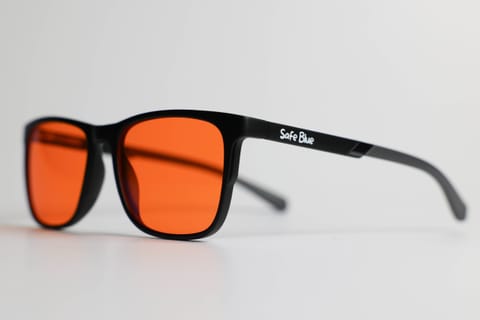
In this frame — and only this one — orange-lens glasses are an accessory some people choose for the evening hours in front of the screen, because they prefer a warmer, less glaring image and want to screen out the blue band in the hours before sleep. Our SAFEBLUE Classic does exactly this, and nothing more: it blocks 99% of light between 400 and 500nm and 85% between 500 and 530nm, with a 65% visible-light transmission. SAFEBLUE is a visual comfort accessory, not a medical device, it has not been studied for headaches, and it is not to be understood as an alternative to the visit we recommended from the start. It costs €49.90 and has 30-day returns: if you try it and it does not give you the comfort you were after, you send it back. That is all we can promise you — and it is already more than many promise.
Frequently asked questions
Do blue light glasses do anything for computer headaches?
There is no evidence that they do. The 2023 Cochrane review on filtering glasses found no demonstrated benefit for short-term eye strain, and no study has shown effects on headaches. If the headache is recurring, the right route is medical assessment, not an accessory.
What are FL-41 lenses and where do you buy them?
They are lenses with a specific rose tint, studied in a clinical setting on people with photophobia, migraine and blepharospasm. They are not the ordinary “anti blue light” glasses sold online. If you think they might interest you, talk to your neurologist or optometrist: they can tell you whether they make sense in your case and point you to an optician able to make them with the correct tint.
Doesn’t the study on children with migraine prove tinted lenses work?
Good’s 1991 study, indexed on PubMed, observed a fall in episode frequency in a sample of 20 children, but the study design cannot rule out the placebo effect, and the result has never been replicated on a large scale with modern methodology. It is an interesting lead for research, not proof to base a purchase on — let alone a health decision.
Can screen light set off a migraine attack?
Many people with migraine report that intense or flickering lights are among their triggers, and the research on photophobia describes a plausible biological circuit linking light and pain. But triggers are highly individual: the headache diary, kept for a few weeks and taken to a doctor, is the most serious way to work out what holds true for you.
When should I worry about a headache?
See a doctor straight away if the pain is sudden and extreme, if it changes character compared to usual, if it comes with fever, a stiff neck, visual disturbances, weakness or confusion, if it follows a trauma, or if it appears for the first time after the age of 50. And even without these signs, a headache that returns several times a month is still worth a visit.
A darker lens screens out more: so is it better?
No, and it is one of the most common mistakes. The clinical research on photophobia (Digre and Brennan, 2012) warns that chronic adaptation to the dark increases sensitivity to light: wearing very dark lenses indoors all day is advised against by the very clinicians who study tinted lenses. If you use a filtering lens, it makes more sense to limit it to specific moments, such as the evening hours.
Can the monitor bother me even without migraine?
Yes. Hours of screen with few breaks are associated with the complaints of so-called Computer Vision Syndrome: dry eyes, blurred vision, neck tension. According to the AAO the main mechanism is reduced blinking, not blue light. Regular breaks, a well-lit desk and an eye test are the first steps.
Does SAFEBLUE recommend its glasses to people who suffer from migraine?
No. Our glasses are a comfort accessory for people who spend their evenings in front of screens, not an answer to a headache. To anyone who suffers from migraine we recommend what we have written throughout this article: a doctor, a symptom diary, an eye test and a sorted-out desk. If after that you also want a pair of evening glasses, we will be here — but afterwards, not in place of everything else.
In short
A computer headache is a real problem, but the answer is not in glasses: it is in seeing a doctor, in a symptom diary and in a sorted-out desk. The research on photophobia and FL-41 lenses is fascinating but rests on small studies and selected clinical populations; the 2023 Cochrane review on filtering glasses calls for caution across the whole category. Orange-lens glasses stay what they are: a comfort accessory for the evening hours in front of the screen, with verifiable physical data and zero health promises. If that is what you are after — and only that — do take a look at our deep-dive on how blue light glasses work. But first, book that appointment.
Sources
- Cochrane Review 2023 — Blue-light filtering spectacle lenses (Singh et al.)
- Digre KB, Brennan KC — Shedding Light on Photophobia (J Neuroophthalmol, 2012)
- American Academy of Ophthalmology — Computers, Digital Devices and Eye Strain
- American Academy of Ophthalmology — Should You Be Worried About Blue Light?
- Harvard Health Publishing — Blue light has a dark side
This article is for information only and does not constitute medical advice. See a qualified optometrist for any vision concerns. SAFEBLUE is a visual comfort accessory, not a medical device.
Related articles
Do blue light glasses work? What the research says
Do blue light filtering glasses work? The honest answer: what the research says, what is debated and when they make sense. No inflated promises.
Digital eye strain symptoms from screens: the guide
Digital eye strain symptoms from screens: how to recognise them, why they happen, the 20-20-20 rule and its limits, and when to see an eye doctor.
Orange vs Clear Lens: The Real Differences
Transmission spectra, blocking percentages and colour rendering: the technical comparison between orange and clear lenses, to work out which suits you.
When to wear blue light glasses: a guide by time of day
Evening yes, daytime it depends, never night driving: a practical guide to when it makes sense to wear blue light glasses, with routines and examples.